 +86 188 1869 1624
 INKBANK01

DTG ink is not simply coloured water. It is a water-based pigment system that must jet through a printhead, wet the garment, form a film during curing and survive the wash and wear conditions defined by the end customer.
This guide explains what DTG ink contains, why white ink behaves differently, how curing works, which fabrics are realistic starting points and what to test before approving a production system.
Ink chemistry determines what is technically possible; fibre, shade depth and the required fastness standard determine what can be approved in production.
Drying is not the same as curing. Curing must remove carrier liquid and form a continuous binder film.
Cotton and cotton-rich garments are the main starting point. Blends, synthetics and heavily finished garments require separate validation.
White ink must be evaluated separately from CMYK for opacity, hand feel, settling, maintenance and wash durability.
Approval should use the actual garment and production process, not a paper print or a single finished sample.
DTG ink is a water-based pigment ink jetted directly onto a finished garment. It normally contains dispersed pigment for colour, a polymeric binder for adhesion and durability, water as the carrier, co-solvents and humectants for jetting, and small amounts of surfactants, defoamers, pH-control agents and preservatives. The exact formulation is product-specific.
Unlike a dye that dissolves and enters a fibre, a pigment remains as dispersed particles. The binder must form a film around those particles and anchor them to the fibre surface. That is why DTG performance depends on more than colour strength alone. Pigment dispersion, binder chemistry, pretreatment and curing all contribute to the final result.
DTG is also different from DTF. DTG jets ink directly onto the garment. DTF prints onto a transfer film, applies a powder or chemical transfer layer, then heat-presses the film onto the fabric. Both use pigment systems, but the transfer path and production risks are different.

A DTG ink formulation combines colour, adhesion, jetting stability and storage stability. The main components are pigment dispersion, polymeric binder, water, co-solvents or humectants, surfactants and smaller additive packages. Formulators adjust these components together; percentages from one product cannot be applied to another.
| Component | Main job | What can go wrong |
|---|---|---|
| Pigment dispersion | Supplies colour and opacity | Oversized particles, poor dispersion or settling can damage jetting and colour consistency |
| Polymeric binder | Bonds pigment to the garment and supports wash and abrasion resistance | Too little can weaken durability; too much can stiffen hand feel or reduce jetting margin |
| Water | Carries the formulation through the printhead and into the fabric | Drying in the nozzle can cause decap or missing nozzles |
| Co-solvents and humectants | Slow evaporation, support nozzle standby and help formulation stability | Poor balance can affect drying, film formation or maintenance behaviour |
| Surfactants | Control surface tension, wetting and droplet spread on the fabric | Incorrect wetting can create bleed, poor edge definition or poor penetration |
| Defoamers, pH buffers and preservatives | Keep the ink stable in the machine, package and storage environment | Imbalance can cause foam, pH drift, sedimentation, odour or shelf-life issues |
The pigment and binder are the performance core. The carrier and additives make that chemistry printable and stable. A low-viscosity ink that jets well but cannot form a durable film is not a successful DTG ink. The same is true of a durable formulation that dries in the nozzle or cannot be maintained in production.
“Water-based” describes the carrier, not the complete formulation. A water-based DTG ink still contains pigments, polymers and functional additives. Buyers should therefore request the technical data sheet and compliance documentation for the exact product, colour and market, rather than treating every water-based ink as equivalent.
White DTG ink needs enough pigment loading and film build to hide the garment colour, especially on dark fabrics. That higher hiding requirement creates a different balance among opacity, hand feel, settling, nozzle maintenance and wash durability. White cannot be evaluated as a simple extra CMYK colour.
On a white shirt, CMYK may sit directly over the garment. On a dark shirt, the printer usually needs a white underbase and a controlled pretreatment process so the white layer hides the background without bleeding or becoming excessively thick.
Formulators must balance:
Opacity versus hand feel.
White coverage versus crack resistance.
Pigment loading versus settling and redispersion.
Wet-film thickness versus curing.
Nozzle idle time versus maintenance demand.
| Evaluation area | White DTG ink | CMYK DTG ink |
|---|---|---|
| Primary job | Hide the garment colour and create a white base for colour graphics | Reproduce colour, gradients and detail |
| Key variables | Pigment load, film thickness, pretreatment uniformity and redispersion | Colour accuracy, ink laydown, gradients and edge definition |
| Main risks | Settling, nozzle maintenance, stiff hand, wash cracking | Bleeding, colour shift, excessive ink and undercure |
| Approval sample | Hide, hand feel, crocking and wash performance on the deepest production colour | Target colour, gradients, fine lines and appearance on the actual garment |
For a print shop, white ink performance should be judged after the agreed pretreatment, print mode, curing profile and wash test. A bright white sample that feels heavy, cracks after washing or blocks nozzles during a realistic shift is not a production-ready result.

DTG curing removes water and co-solvents, then supplies enough heat and time for the binder particles to coalesce into a continuous film. Drying alone is not necessarily curing. The required temperature, dwell time and pressure depend on the specific ink, garment, pretreatment, dryer or heat press and production conditions.
The process can be understood in five stages:
Droplet formation: The printhead ejects a stable ink droplet.
Wetting and penetration: The droplet spreads onto the pretreated garment surface.
Carrier removal: Water and co-solvents leave the film during drying.
Binder coalescence: Polymer particles come together and form a continuous film.
Cured print: The pigment is anchored strongly enough for the agreed wash, rub and wear requirements.
The platen or heat-press display is not proof that the ink reached the required condition. Garment thickness, moisture, fabric construction and the actual surface temperature affect heat transfer. A heavy sweatshirt and a thin T-shirt may not reach the same condition under an identical setting.
Ask the technical team for:
The recommended curing window for the exact ink.
Whether the target is dryer cure or heat-press cure.
How to measure garment surface temperature and dwell time.
A test procedure for undercure and overcure.
The maximum temperature the garment can tolerate.
| Item to confirm with the supplier | Why it matters |
|---|---|
| Curing window for the exact ink | Different colours, white ink and formulations may require different conditions |
| Dryer cure or heat-press cure | The two methods transfer heat differently |
| Garment surface temperature and dwell time | The machine display is not proof of the actual condition |
| Method for identifying undercure and overcure | Both wash failure and heat damage must be prevented |
| Maximum temperature the garment can tolerate | Blends, elastane and surface finishes are more heat-sensitive |
Undercuring can leave the film weak, increase crocking and reduce wash durability. Excessive heat can yellow white garments, change synthetic fibres, create a stiff hand or damage elastane and surface finishes.
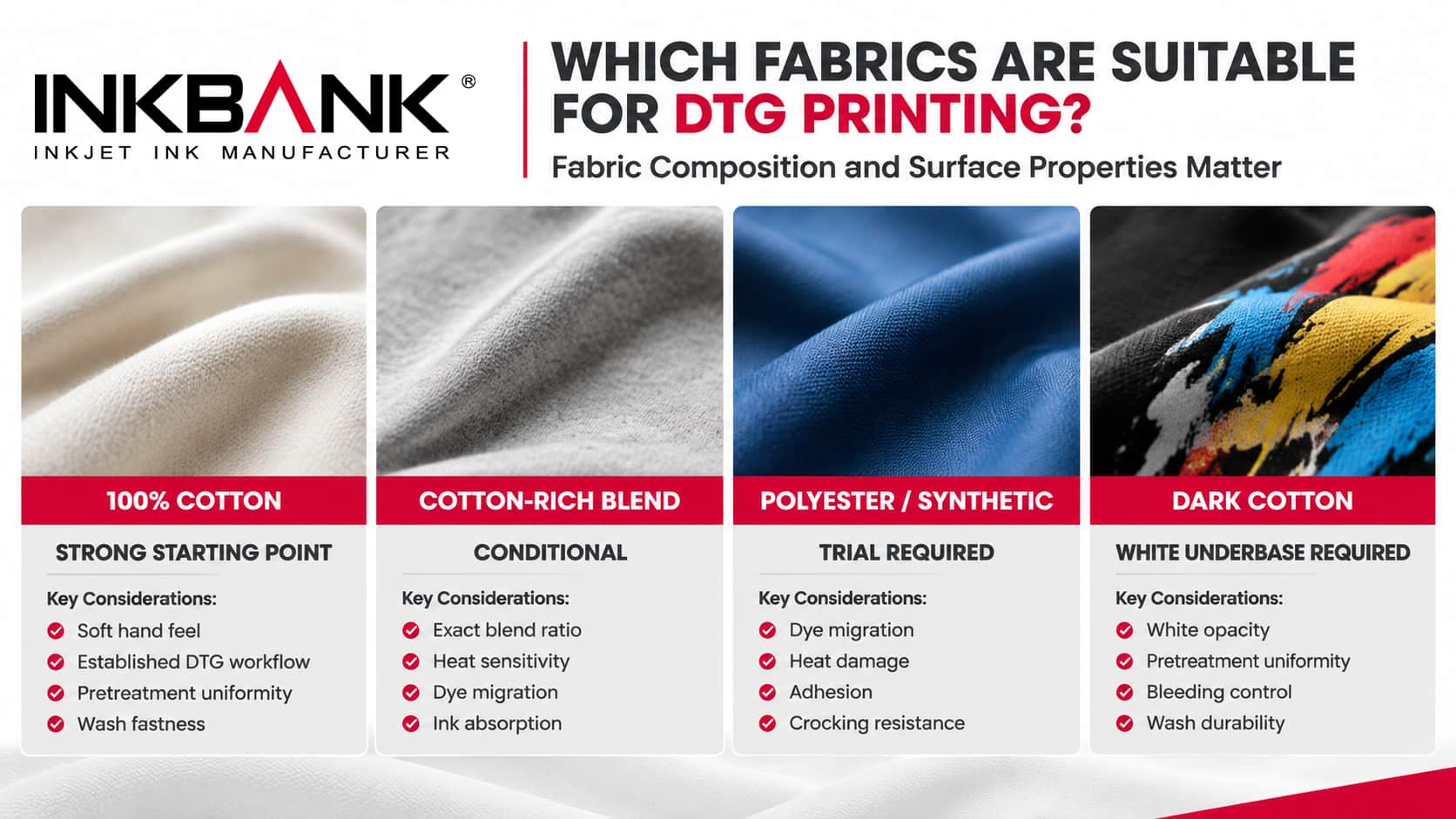
Cotton and cotton-rich garments are the primary DTG starting point because cellulosic fibres accept water-based pigment systems and commonly used pretreatments. Blends, polyester, synthetic fibres and heavily finished garments can sometimes be evaluated, but they require system-specific pretreatment, lower heat exposure and separate wash testing.
| Fabric route | Typical fit | Main opportunity | Main risks to test |
|---|---|---|---|
| 100% cotton | Strong starting point | Soft hand, good colour and established DTG workflow | Fibre quality, pretreatment uniformity, white opacity and wash fastness |
| Cotton-rich blend | Conditional | Can combine cotton feel with blend economics | Exact blend ratio, heat sensitivity, dye migration and uneven ink absorption |
| Polyester or synthetic-rich blend | Trial required | Possible with the right pretreatment and ink system | Dye migration, heat damage, crocking, adhesion and different hand feel |
| Dark cotton | Strong screening case | White underbase plus CMYK supports high-impact graphics | Hide, bleeding, white hand feel, cracks and wash loss |
| Garment with stain-release, softener or water-repellent finish | High risk | Finish may improve consumer feel | Finish can block wetting or binder adhesion; wash and recoat may change performance |
“DTG compatible” should therefore be treated as a process statement, not a universal fabric claim. A DTG ink approved on one cotton jersey may not behave the same on a compact cotton, a heavy fleece, a polyester-rich blend or a garment treated with a durable water-repellent finish.
Fabric composition is only one variable. Yarn type, knit structure, surface hairiness, absorbency, thickness, moisture content and colour all affect how the droplet spreads and how the cured film behaves.
For dark garments, surface texture also changes the amount of white needed for a clean result. A fibre-reactive cotton that looks similar to another cotton fabric may require different pretreatment and print settings.
DTG pretreatment prepares the garment to receive pigment ink. It can influence wetting, bleed control, white opacity, colour development, hand feel and wash durability. Pretreatment chemistry is not universal, and changing the pretreatment without retesting the ink can invalidate a previously approved result.
Pretreatment is not a generic “prep liquid.” Different products are designed around different ink chemistries, garment types and application methods. The same ink may produce different colour and hand feel when the pretreatment solids, wet pickup, drying method or storage condition change.
When a print shop changes any part of the system, it should repeat the relevant checks:
Ink series or colour.
Pretreatment product or concentration.
Print mode, ink laydown or white-layer setting.
Dryer or heat-press condition.
Garment supplier, fabric lot or surface finish.
Wash and rub standard.
This is also why a supplier should not approve a DTG ink from a paper swatch or a single printed T-shirt. Approval should be based on the garment and process that will enter production.

| Decision factor | DTG ink | DTF ink |
|---|---|---|
| Ink path | Jetted directly onto the garment | Printed onto film, then transferred |
| Typical fabric starting point | Cotton and cotton-rich garments | Broader range of fabrics and blends |
| Main durability mechanism | Pigment plus binder film fixed on the garment | Pigment plus transfer adhesive layer |
| Hand feel | Can be soft when the ink, pretreatment and cure are balanced | Depends on film, powder or chemical layer and transfer settings |
| Additional process | Pretreatment and curing | Film printing, transfer layer, powder or chemical application and pressing |
| Best order profile | Short runs, sampling, high-mix garment decoration | Gang sheets, transfer stock and fabrics that are difficult for DTG |
| Main failure modes | White opacity, bleed, crocking, nozzle maintenance, undercure | Film cracking, adhesive feel, powder handling and transfer defects |
Neither route is universally better. DTG can offer a direct-on-garment result and a soft hand on suitable cotton garments. DTF can simplify transfer production and extend the range of fabrics. The right route depends on the garment, artwork, order profile, hand-feel target and durability standard.
| Order scenario | Preferred starting route | Reason | Main validation |
|---|---|---|---|
| Small cotton T-shirt runs with frequent artwork changes | DTG | No screens and a direct-on-garment workflow | Pretreatment, white opacity, hand feel and cure |
| Cotton blends or stretch fabrics where DTG is not stable | DTF | Broader fabric coverage and a separate transfer layer | Stretch, adhesion, hand feel and wash |
| Pre-produced transfers or pressing at another location | DTF | Designs can be held as transfer film | Film batch, transfer condition and storage |
| Dark cotton with high-opacity graphics | DTG | White underbase plus CMYK creates high contrast | Hide, bleeding, crocking and wash cracking |
For a deeper comparison, read DTF vs DTG vs Sublimation: The Complete 2026 Comparison.

A DTG ink should be approved on the actual garment through appearance, durability, production reliability and cost tests. A printed sample alone is insufficient. Keep the pretreatment, print mode, cure condition and test method attached to every result so the approval can be repeated.
| Test area | What to measure | Evidence to request |
|---|---|---|
| Colour and detail | Colour accuracy, gradients, fine lines and edge definition | Labelled print target with ink, garment, pretreatment and print mode |
| White opacity | Hide on the deepest production colour | Comparison against an approved physical standard |
| Hand feel | Stiffness, surface texture and drape | Blind comparison after conditioning |
| Wash fastness | Colour change, staining, cracking and delamination after the agreed procedure | Test method, temperature, cycles, detergent and drying condition |
| Crocking | Dry and wet rub performance | Method, rubbing cloth, load and rating |
| Dimensional behaviour | Print distortion or garment shrinkage after wash and heat | Before-and-after measurements |
| Jetting | Missing nozzles, deflection, spatter and recovery after idle | Production-length trial and restart log |
| Maintenance | Wipe, purge, decap and white-ink redispersion demand | Cleaning frequency and consumable use |
| Batch consistency | Colour and physical properties across batches | COA, retention samples and change-control procedure |
| Shelf life | Separation, viscosity and performance through usable life | Storage conditions and expiry basis |
Do not compare a fastness grade from one supplier with another unless the test method and conditions are known. “Grade 4” is not a universal, stand-alone result.
| Symptom | Likely system causes | What to check first |
|---|---|---|
| White looks weak or blue-grey on dark garments | Low white laydown, uneven pretreatment, wet pickup or garment texture | Pretreatment coverage, white setting, garment surface and cure |
| Colour bleeds beyond the artwork edge | Excessive ink, poor pretreatment, fabric wicking or platen moisture | Pretreatment dose, ink limit, fabric and drying condition |
| Print fades or cracks after washing | Undercure, insufficient binder performance, over-thick film or poor pretreatment fit | Surface temperature, dwell time, film thickness and wash method |
| Colour transfers in wet rubbing | Incomplete film formation, surface pigment or incompatible chemistry | Cure, binder system, ink laydown and test method |
| Nozzles drop out during idle time | Ink drying in the nozzle, weak decap or maintenance mismatch | Idle interval, capping station, humidity and ink series |
| White pigment settles or blocks circulation | High pigment loading, weak redispersion or inadequate ink management | Agitation, circulation, storage and maintenance procedure |
| Garment yellows around the print | Excessive heat, scorching or finish interaction | Curing window, garment heat tolerance and moisture |
| Print feels stiff | Excessive white or binder film, high ink laydown or wrong pretreatment | White laydown, print mode and pretreatment solids |
The root cause is rarely “bad ink” alone. Record the complete process before changing one variable.

Evaluate the supplier against the production system, not the price per litre. The supplier should define ink compatibility, provide a technically complete TDS, support a garment-based trial, document batch controls and explain how pretreatment, curing and maintenance fit the proposed ink.
Ask for:
The exact ink series and colour range proposed.
A written compatibility scope for the printer, ink-delivery system and printhead.
Recommended pretreatment conditions.
A starting cure window and a method to verify it.
Wash, rub and hand-feel results with the test method attached.
Batch controls, COA, retention samples and change notification.
Shelf life, storage and shipping requirements.
Current compliance documents by product, colour and target market.
A trial record that includes preparation, restarts and maintenance.
A cost model based on acceptable garments, not only ink price.
INKBANK manufactures digital inkjet inks for textile, packaging, UV-LED, PCB and other industrial applications. The company has specialised in digital inkjet ink R&D and manufacturing for 20+ years, with 40,000+ tonnes of annual ink production capacity, a 50,000 m² R&D and production base, 16 R&D laboratories and more than 500 test printers.
INKBANK's DTG pigment ink range is positioned for cotton garment printing and related natural-fibre applications. Product-page information highlights polymer-binder chemistry, colour output and technical test areas. Product fit, white-ink performance, pretreatment compatibility and curing conditions still need to be confirmed on the intended garment and equipment system.
For technical evaluation, start with the exact garment, deepest colour, pretreatment route, print mode, cure method and required test standard. These inputs allow the discussion to move from a generic ink claim to a measurable sample plan.
Review INKBANK DTG pigment ink or request an application assessment.
No. DTG ink normally contains pigment, a polymeric binder, water, co-solvents or humectants and smaller additive packages for wetting, defoaming, pH control and storage stability. The binder is essential to adhesion and durability.
No. Cotton and cotton-rich garments are the main starting point. Blends, polyester-rich fabrics, synthetics and heavily finished garments require separate pretreatment and production validation.
White ink requires high pigment loading and enough film build to hide the garment colour. This creates trade-offs among opacity, hand feel, settling, maintenance and wash durability.
Some DTG systems can be cured with a heat press, but the press setting is not automatically the ink cure specification. Confirm the required garment surface temperature, time, pressure and protection sheet with the ink and equipment supplier.
There is no universal time that applies to every ink, pretreatment, garment and curing device. Use the TDS and a validated garment-based procedure, then verify cure through wash and crocking tests.
Water-based does not automatically mean low-impact in every dimension. Environmental performance depends on formulation, energy use, pretreatment, packaging, wastewater and the compliance scope. Request current documents for the exact product and market.
DTG ink is printed directly onto the garment. DTF ink is printed onto film and transferred with an adhesive layer. DTG usually starts with cotton-rich garments; DTF can cover a broader fabric range but adds film and transfer steps.
Print the deepest production colour on the actual garment, using the proposed pretreatment, print mode and cure method. Record appearance, hand feel, wash fastness, wet and dry crocking, jetting, restart behaviour and maintenance before approving bulk supply.
Tawiah, Howard and Asinyo, “The Chemistry of Inkjet Inks for Digital Textile Printing,” 2016. Technical review.
Sun Chemical, “Digital Textile Printing with Pigment Inks.” White paper.
INKBANK, Direct to Garment (DTG) Pigment Ink.
This article is a technical buying guide. It does not replace the current TDS, equipment instructions, compliance documents or a garment-based production trial for a specific ink system.
Related Products
Contact Us
Hello, welcome to submit any questions and suggestions. We will reply to you as soon as possible. Thank you for your support and help.


