 +86 188 1869 1624
 INKBANK01

Every leather printer knows the compromise: water-based inks that feel soft but print dull on dark substrates — or solvent-based inks that pop with color but off-gas VOCs and crack when the product flexes. "Eco-friendly or sellable. Pick one."
It's been the industry's binary choice for years. INKBANK's R&D team treated it as an engineering problem — and built a solution from the chemistry up.
The result is a three-component water-based latex system: color ink, white ink, and optimized pre-treatment (OP). Each engineered to outperform the compromise. What follows is the test data behind each component.
A water-based latex ink for leather isn't one product. It's three — and all three have to work together.
Color ink carries the visual payload. Color density, saturation, gloss — all determined here. Color ink also shoulders the fastness burden: every rub, wipe, and cleaning product contacts the color layer first.
White ink masks the substrate. On black leather, if the white underbase doesn't deliver enough hiding power, CMYK layers paint on a dark canvas — muted color, thick hand feel from extra ink loading.
OP (Optimized Pre-treatment) is the least visible and most consequential component. It controls whether ink bonds to the surface or bleeds into it. Too little — edge sharpness collapses. Too much — the residue becomes a weak interlayer compromising every fastness metric.
Most latex ink systems are strong in one component and adequate in the other two. INKBANK's R&D team set a higher benchmark: measurable excellence across all three.

Color density determines whether a printed leather product looks premium or washed-out. Higher density = deeper, more saturated color. Measured by spectrophotometer on leather substrates under standardized print conditions.
| Color | INKBANK Density |
|---|---|
| Cyan | 1.68 |
| Magenta | 1.75 |
| Yellow | 1.09 |
| Black | 1.67 |
On white leather, prints show deep blacks, saturated colors, and high gloss. On black leather — with the white underbase providing clean separation — color layers maintain saturation without substrate darkening.
Measured by color difference (ΔE) after standardized abrasion. Lower ΔE = less color transferred = better fastness.
| Color | ΔE & ISO Grade |
|---|---|
| Cyan | 6.40 ΔE · Grade 3-4 |
| Magenta | 6.17 ΔE · Grade 3-4 |
| Yellow | 1.53 ΔE · Grade 4-5 |
| Black | 4.43 ΔE · Grade 4 |
Yellow reached Grade 4-5 — near the theoretical ceiling for dry abrasion on flexible leather. All four colors achieved commercially viable dry rub performance for fashion accessories, footwear, automotive interiors, and promotional goods.

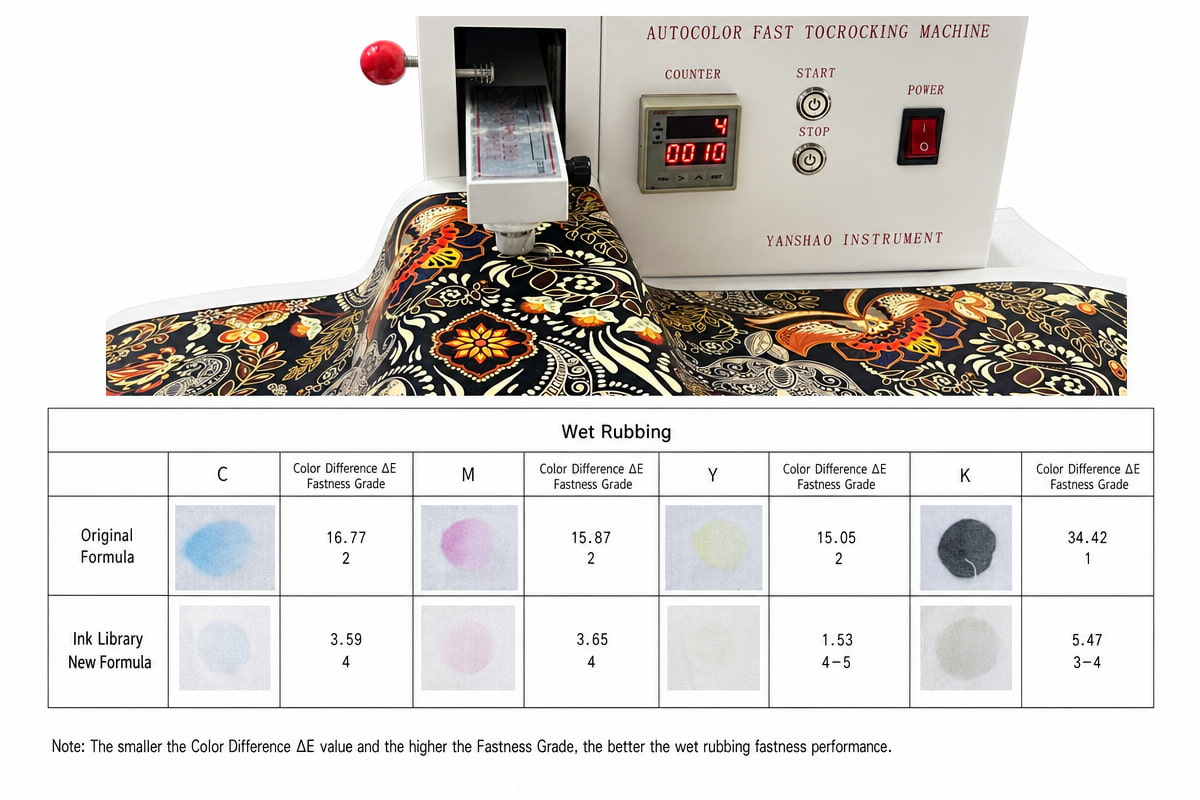
The harder test. Leather goods encounter rain, sweat, cleaning products — moisture plus abrasion. INKBANK's R&D team made this the primary focus of the latest formulation cycle. The improvement was not incremental:
| Color | Original Formula | New Formulation |
|---|---|---|
| Cyan | 16.77 ΔE · Grade 2 | 3.59 ΔE · Grade 4 |
| Magenta | 15.87 ΔE · Grade 2 | 3.65 ΔE · Grade 4 |
| Yellow | 15.05 ΔE · Grade 2 | 1.53 ΔE · Grade 4-5 |
| Black | 34.42 ΔE · Grade 1 | 5.47 ΔE · Grade 3-4 |
The improvement is non-linear:
— Cyan: Grade 2 → Grade 4
— Yellow: Grade 2 → Grade 4-5
— Black: Grade 1 → Grade 3-4
This is not an incremental formulation tweak. It's a different polymer cross-linking architecture. For the majority of leather applications — fashion accessories, footwear, automotive interiors, stationery — INKBANK's Grade 3-5 wet rub performance is commercially sufficient. INKBANK's R&D team continues to iterate on wet rub as part of the ongoing formulation development program.
White ink is where most latex systems collapse on dark substrates. Titanium dioxide (TiO₂) — the pigment that makes white ink white — is dense. It settles. It clogs printheads. To compensate, formulators dilute the TiO₂ concentration — which means more ink to achieve opacity, thicker ink film, stiffer hand feel. A cascade of compromises starting from one physics problem.
INKBANK's approach: reformulate the dispersion system to keep TiO₂ suspended at higher concentration without sacrificing jetting reliability.
White blocks were printed at 10%-100% ink volume gradients on black leather to determine the minimum ink volume for commercially acceptable opacity.
INKBANK white ink achieves full opacity at 40% ink volume on black leather
High-concentration TiO₂ dispersion delivers hiding power at low ink loading — thinner film, softer hand feel, lower cost per print.
Test condition: 1.4m print width, 100% ink volume, bidirectional high-speed mode — worst-case for white ink fluidity.
| Metric | INKBANK New White |
|---|---|
| Continuous print area before nozzle degradation | 25 ㎡ |
| Improvement vs. original formula | +67% |
For a production shop running 500 units/day: uninterrupted shifts vs. mid-run cleaning cycles.
White ink sits in cartridges, tubes, and printheads — sometimes for days between jobs. Test: 60°C accelerated aging for 3 days (equivalent to weeks of shelf storage).
Result: Zero visible stratification. All post-aging physical and chemical parameters within specification. Filtration index (FI) normal.
The dispersion held. White ink that's ready to print when the job is — not after an hour of cartridge shaking and nozzle cleaning.
Production-grade printers circulate white ink continuously to prevent settling. Test: peristaltic pump at production flow rates, measured at 0h / 24h / 48h.
| Metric | Value |
|---|---|
| Initial flow rate | 102.2 g/min |
| Flow rate at 24h | 101.7 g/min |
| Flow rate at 48h | 101.3 g/min |
| Total flow rate decay | -0.88% |
| Filter condition after 48h | Clean, no abnormal residue |
Flow rate decay under 1% after 48 hours confirms the dispersion resists shear-induced aggregation — the ink stays stable even under continuous circulation stress.

OP's job is to anchor ink to the substrate — but every gram of OP left on the leather after fixation becomes a liability. Residual OP is a weak interlayer that degrades fastness, attracts moisture, and can migrate to the surface as a hazy film. The performance benchmark is inverted: achieve reliable fixation with the least possible fluid.
Test: identical CMYK patterns on leather using INKBANK OP at varying concentrations. Measured edge sharpness, ink bleed, and color fastness.
| OP Concentration | Result |
|---|---|
| 8% | ✅ No bleeding. Sharp edges. Full fixation. |
| 12% | — (8% already sufficient) |
| 15% | — |
INKBANK OP achieves full fixation at just 8% concentration
Less residual chemistry. Shorter drying. Lower risk of clouding. Fewer production variables.
OP usage is intermittent — a batch can sit idle between jobs for extended periods. Test: extended ambient-temperature aging.
Result: No change in appearance. Performance remained consistent with fresh OP throughout the test period. No phase separation, no turbidity, no degradation in fixation.

Individual component data matters. But a latex ink system is judged as a system — the white layer, the color layer, and the pre-treatment interface must perform in concert on the same substrate, under the same cure conditions, in the same production environment.
On white leather: High color saturation, deep blacks, and high gloss. Detail inspection shows sharp dot placement and minimal inter-color bleeding — driven by the OP's fixation precision at low concentration.
On black leather: White ink opacity at 40% volume combines with color density to keep substrate darkening from muting the image. Color layers maintain intended saturation.
Fastness balance: Dry rub Grade 3-4 to Grade 4-5 across all CMYK. Wet rub improved from Grade 1-2 to Grade 3-5 — a step-change from new polymer cross-linking architecture. INKBANK's R&D continues active formulation iteration.

| Parameter | Detail |
|---|---|
| Ink Type | Water-Based Latex Ink (3-component system: Color + White + OP) |
| Color Density | C 1.68 · M 1.75 · Y 1.09 · K 1.67 |
| White Ink Hiding Power | Full opacity at 40% ink volume on black leather |
| White Ink Fluidity | 25 ㎡ continuous at 100% volume, 1.4m width, bidirectional |
| White Ink Circulation | 48h continuous, flow decay <1% |
| White Ink Stability | Zero stratification after 60°C/3d accelerated aging |
| Dry Rub Fastness | C 3-4 · M 3-4 · Y 4-5 · K 4 (ISO Grade) |
| Wet Rub Fastness | C 4 · M 4 · Y 4-5 · K 3-4 (ISO Grade) |
| OP Fixation | Full fixation at 8% concentration |
| OP Stability | No phase separation during extended idle storage |
| Compatible Printheads | EPSON I3200 and above |
| Applicable Substrates | White & black leather, PU, PET, PVC, non-porous flexible media |
| Product Page | Water-Based Latex Ink → |
1. This is transparent performance data from an ink manufacturer. The numbers above are the full R&D test matrix for INKBANK's three-component latex system. Print service providers make capital allocation decisions based on performance data — publishing the data, rather than surrounding it with marketing copy, is the point.
2. The system-level performance is material. White ink achieves opacity at 40% volume. Color density is measured and published for all four CMYK channels. OP achieves fixation at 8% concentration. White ink shows zero stratification after accelerated aging. These are production-relevant metrics that affect consumable cost, throughput, quality consistency, and maintenance downtime.
3. The formulation is still improving. The jump from original to new formulation — particularly wet rub (Grade 1-2 → Grade 3-5) — demonstrates active R&D iteration. This is an active development program.
You've seen the test data. The next step: print it on your substrate, in your production environment, to your quality standards. Include your substrate type and printhead configuration — samples ship within 5 business days with ICC profiles included.
Request Latex Ink Evaluation Samples →Or explore the full product specification
INKBANK Group — Nearly 20 years of digital inkjet ink R&D and manufacturing. 50+ patents. 40,000-ton annual capacity. Products shipped to 100+ countries. The test data above was generated by INKBANK's R&D laboratory under standardized print conditions. Individual production results may vary based on substrate, equipment, and environmental factors.
Contact Us
Hello, welcome to submit any questions and suggestions. We will reply to you as soon as possible. Thank you for your support and help.


