


By INKBANK Group · Published September 2026 · UV-LED ink for advertising, signage and display printing
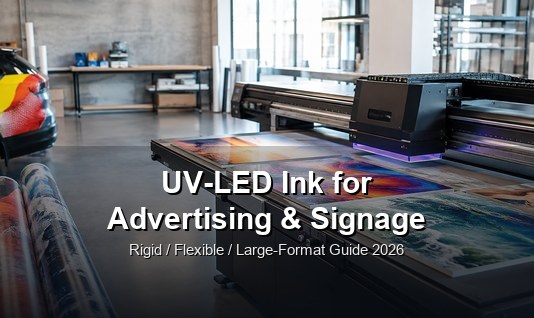
UV-LED ink is the fastest-growing ink technology in advertising and signage because it cures instantly, prints on both rigid and flexible media, and produces graphics that survive outdoor weather, bending, and repeated handling. For sign makers, banner producers, and display printers, the practical question is not whether to use UV ink, but which UV ink family fits the application.
This guide explains how UV-LED ink works for advertising, the difference between flexible, rigid, and hybrid formulations, which substrates and printheads are compatible, and how to choose the right ink system for your shop.
Why Advertising Printers Are Switching to UV-LED Ink
UV-LED ink is a photopolymer ink that changes from liquid to solid in fractions of a second when exposed to UV-LED light. Because the ink does not rely on evaporation, there is no drying tunnel, no waiting time, and no heat-sensitive film damage. That changes how a signage production line is organized.
Instant cure: prints can be handled, laminated, and delivered immediately after the curing station.
Broader media range: one UV system can cover rigid boards, flexible films, metals, acrylic, and coated glass.
High durability: UV films resist scratching, alcohol, and outdoor weathering when the right formulation is used.
Compact footprint: LED curing units are small enough for roll-to-roll and flatbed printers.
Lower energy and heat: LED lamps consume less energy than mercury arc lamps and do not overheat heat-sensitive substrates.
| Factor | UV-LED ink | Eco-solvent ink | Latex ink |
|---|---|---|---|
| Drying mechanism | Instant UV curing | Evaporation | Heat and air |
| Rigid substrate printing | Excellent | Limited | Limited |
| Heat on substrate | Low | Low | Higher |
| Production speed | High | Medium | Medium |
| Typical use | Signs, banners, wraps, POP, displays | Banners and flexible graphics | Flexible graphics and wall décor |
The Three UV-LED Ink Families for Signage and Display
Not all UV ink is the same. The formulation determines whether a print cracks when bent, scratches when handled, or loses adhesion on a specific substrate. INKBANK classifies advertising UV inks into three families.
Flexible UV-LED Ink
Flexible UV ink is formulated for media that bend, stretch, and wrap. INKBANK Flexible UV-LED Curable Ink delivers over 180% stretchability without cracking, with excellent low-temperature resistance for vehicle wraps and thermoformed signage. It achieves Grade 0 adhesion on soft films, car stickers, wallpaper, knife scraping cloth, 3P cloth, light sheet, PVC transparent films, and leather.
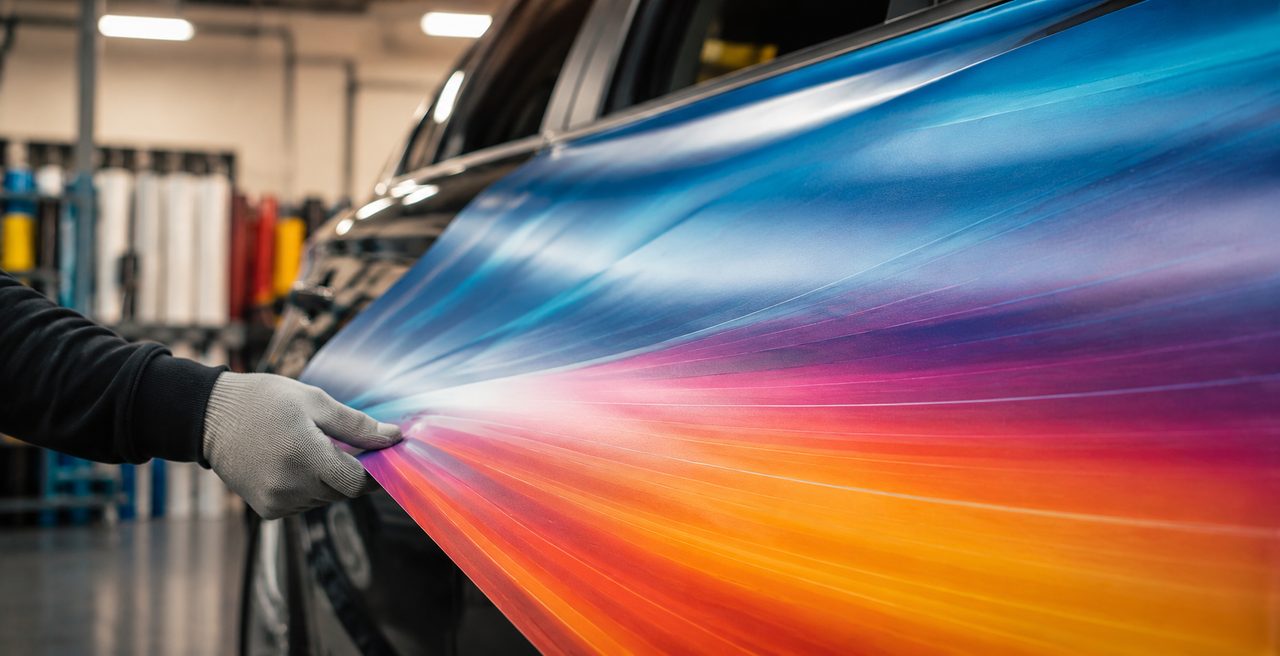
Color options include CMYK plus white, light cyan, light magenta, and varnish, with special and fluorescent colors available. A dedicated UV varnish increases gloss, brightness, and scratch resistance for premium decals and leather finishes.
Rigid UV-LED Ink
Rigid UV ink is designed for flatbed printing on hard substrates. INKBANK Rigid UV-LED Curable Ink offers 6H pencil hardness, strong alcohol resistance, and excellent resistance to scratching and peeling. It delivers Grade 0 adhesion on acrylic, PC, PS, PVC, PET, KT boards, skinned boards, ABS, coated metal, and coated glass, with a deep black and high ink brightness for premium commercial output.
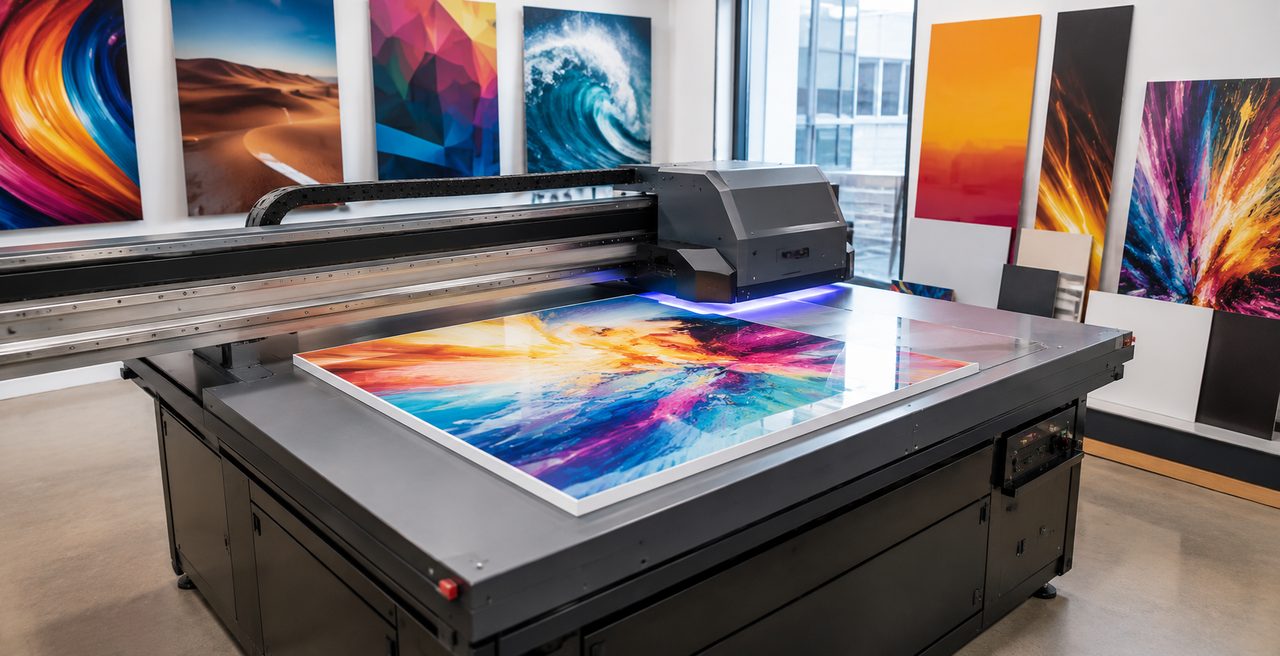
The color set covers CMYK, light cyan, light magenta, white, red, green, orange, and varnish. The varnish can be used for 3D embossing and raised printing effects on flatbed printers.
Medium (Hybrid) UV-LED Ink
Medium UV ink balances flexibility and rigidity, making it the bridge between roll-to-roll and flatbed production. INKBANK Medium UV-LED Curable Ink supports both sheet and coil printing and provides high-density adhesion on acrylic, PVC, PC, TPU mobile phone cases, soft films, car stickers, and light sheet without pre-coating layers.
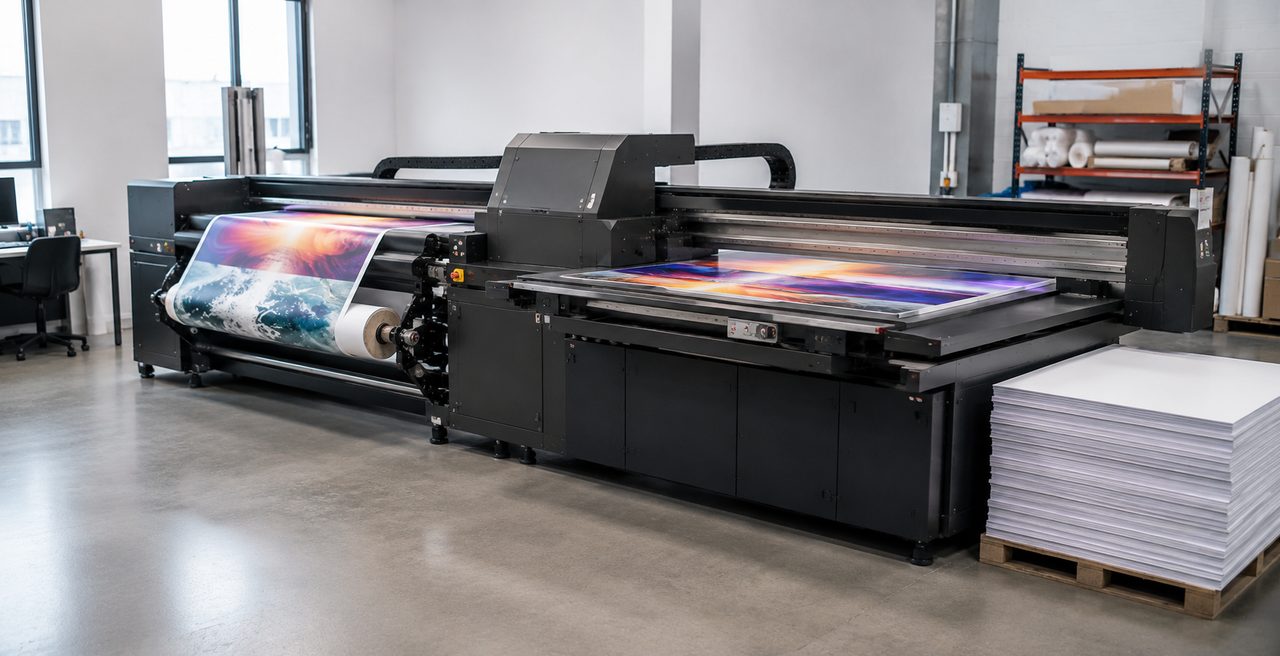
For hybrid printers that switch between flexible banners and rigid display panels, a medium formulation reduces inventory because one ink handles both categories. The optional varnish adds gloss, texture, 3D embossing, and weather protection.
Flexible vs Rigid vs Hybrid: Which UV Ink Do You Need?
| Criterion | Flexible UV | Rigid UV | Medium / Hybrid UV |
|---|---|---|---|
| Best for | Vehicle wraps, banners, soft signage, curved surfaces | Flatbed signs, POP, wayfinding, acrylic and metal | Hybrid roll-to-roll + flatbed shops |
| Key performance | 180%+ stretchability, low-temperature resistance | 6H hardness, alcohol resistance, scratch resistant | Balance of flexibility and durability, no pre-coating |
| Typical substrates | Soft film, vinyl, leather, wallpaper, PVC film | Acrylic, PC, PVC, PET, KT board, ABS, coated metal/glass | Both flexible films and rigid boards, TPU cases |
| Value add | Varnish, special and fluorescent colors | Varnish, 3D embossing, deep black | One system for two production modes |
Signage and Display Applications That Use UV-LED Ink
| Application | Recommended ink family | Why it works |
|---|---|---|
| Vehicle wraps and car stickers | Flexible | 180%+ stretchability, no cracking when bent |
| Roll-up banners and soft signage | Flexible | Instant cure and flexible film adhesion |
| Wayfinding and flatbed signage | Rigid | 6H hardness and scratch resistance |
| POP and retail displays | Rigid or hybrid | Adhesion on acrylic, PVC, and foam boards |
| Window graphics and wall décor | Flexible or hybrid | Soft film and wallpaper compatibility |
| 3D embossed signage and spot UV | Rigid or hybrid + varnish | Varnish builds raised texture and protection |
| Thermoformed signs | Flexible | Low-temperature resistance during forming |
Printhead Compatibility and Running Performance
UV ink must match the printhead platform and the machine's waveform settings. INKBANK advertising UV inks are validated on EPSON T3200, I3200, S3200, F1440, and L1440, KYOCERA KJ-4A, RICOH G5 and G6, FUJIFILM SAMBA and SG1024, KONICA 1024i, and SEIKO 1024GS printheads.
Production fluency matters as much as compatibility. The technical data for INKBANK UV advertising inks shows no missed lines and no oblique spray after printing 20 square meters, with cleaning intervals of 0.5 hours in the standard test cycle and Grade 0 adhesion across the tested substrate range. Ask any supplier for the same level of batch data before you run a production trial.
Compliance and Indoor Safety
For indoor signage, POP displays, and retail environments, chemical compliance is a buying requirement, not an option. INKBANK Flexible, Rigid, and Medium UV-LED inks pass the EU REACH restricted substance test and comply with the limit values required by RoHS certification. The UV ink portfolio also includes products carrying GREENGUARD GOLD certification; confirm the current certificate for the specific product line you are evaluating.
A dedicated varnish improves gloss and brightness and adds an extra protective layer, which is especially valuable for premium signage, high-end decals, and 3D effects.
How to Choose a UV Advertising Ink Supplier
Test the ink on your exact substrates, including flexible films, rigid boards, and coated metals.
Verify printhead compatibility and the recommended waveform and curing settings.
Request the technical data sheet, safety data sheet, and batch certificates before purchase.
Run a production trial that includes bending, scratching, alcohol wiping, and outdoor exposure.
Confirm REACH, RoHS, and any destination-market certifications for your product line.
Ask about varnish, special colors, and custom formulation support.
Evaluate response time for troubleshooting and on-site or remote application support.
FAQ
What is UV ink for advertising?
UV ink for advertising is a photopolymer ink that cures instantly under UV-LED light. It is used for signage, banners, vehicle wraps, POP displays, and rigid boards because it prints on many substrates without drying time.
What is the difference between flexible and rigid UV ink?
Flexible UV ink stretches and bends without cracking, making it suitable for vehicle wraps, banners, and curved surfaces. Rigid UV ink is harder and more scratch resistant, making it suitable for acrylic, metal, and flatbed sign panels.
Can one UV ink print both banners and rigid boards?
Yes. Medium or hybrid UV ink is designed for both roll-to-roll and flatbed printing. It combines the flexibility needed for films with the durability needed for rigid boards.
Which substrates can UV-LED ink print on?
UV-LED ink can print on flexible media such as soft film, vinyl, PVC film, and leather, and rigid media such as acrylic, PC, PVC, PET, KT board, ABS, coated metal, and coated glass. The exact range depends on the formulation.
Is UV ink safe for indoor signage?
Yes, when the formulation meets the relevant compliance requirements. INKBANK advertising UV inks pass the EU REACH restricted substance test and comply with RoHS limit values, and part of the UV portfolio carries GREENGUARD GOLD.
Does UV ink require special printheads?
UV ink must be matched to a compatible printhead and waveform. INKBANK validates its advertising UV inks on Epson, Kyocera, Ricoh, Fujifilm, Konica, and Seiko printhead platforms.
How durable are UV prints for outdoor advertising?
Durability depends on the ink, substrate, and lamination. Flexible UV formulations provide low-temperature resistance and high stretchability, while rigid formulations provide 6H pencil hardness and alcohol resistance. Confirm outdoor requirements with a production test.
What is varnish in UV printing?
Varnish is a UV-curable clear ink that adds gloss, brightness, and scratch protection. It can also create 3D embossing and spot UV effects for premium signage and displays.
Is UV-LED ink faster than eco-solvent ink?
UV-LED ink cures instantly, while eco-solvent ink requires evaporation time. This removes the drying step and allows inline finishing in many roll-to-roll and flatbed workflows.
How do I choose a UV ink supplier for advertising?
Verify substrate adhesion, printhead compatibility, batch documentation, REACH and RoHS compliance, varnish and special color options, and production-scale test results before you commit to a supplier.
Related Resources
Flexible UV-LED Curable Ink — 180% stretchability for wraps, banners, and flexible media
Rigid UV-LED Curable Ink — 6H hardness for acrylic, metal, and rigid boards
Medium UV-LED Curable Ink — hybrid ink for roll-to-roll and flatbed printing
What Is UV Ink? Complete Guide — UV-LED technology explained
UV-LED Ink Selection Guide 2026 — selection criteria and application scenarios
Certifications — REACH, RoHS, GREENGUARD GOLD and more
Contact INKBANK — request samples or technical consultation


