


By INKBANK Group · Published August 2026 · Complete technical guide
1. The Pile Fabric Printing Challenge
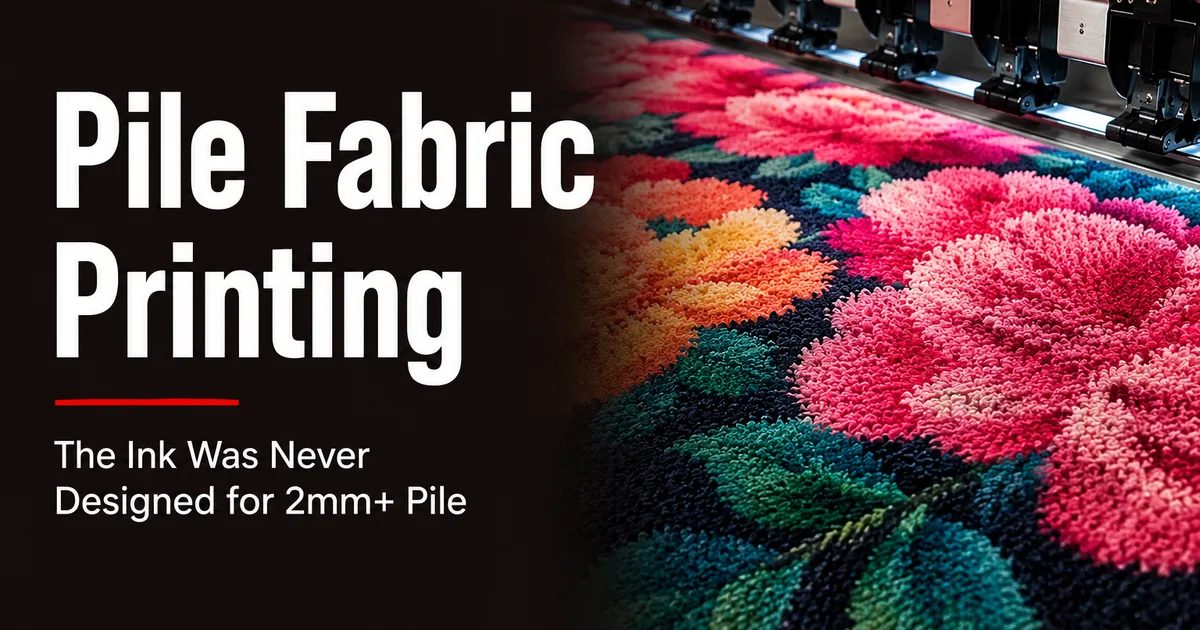
Digital textile printing has conquered flat woven fabrics. T-shirts, banners, soft signage — solved problems. But walk into a mill printing coral fleece blankets or flannel throws at 2mm+ pile height, and you'll hear the same complaint from every production manager:
"Same machine. Same process. Same RIP. But the ink just won't work the way it does on flat fabric."
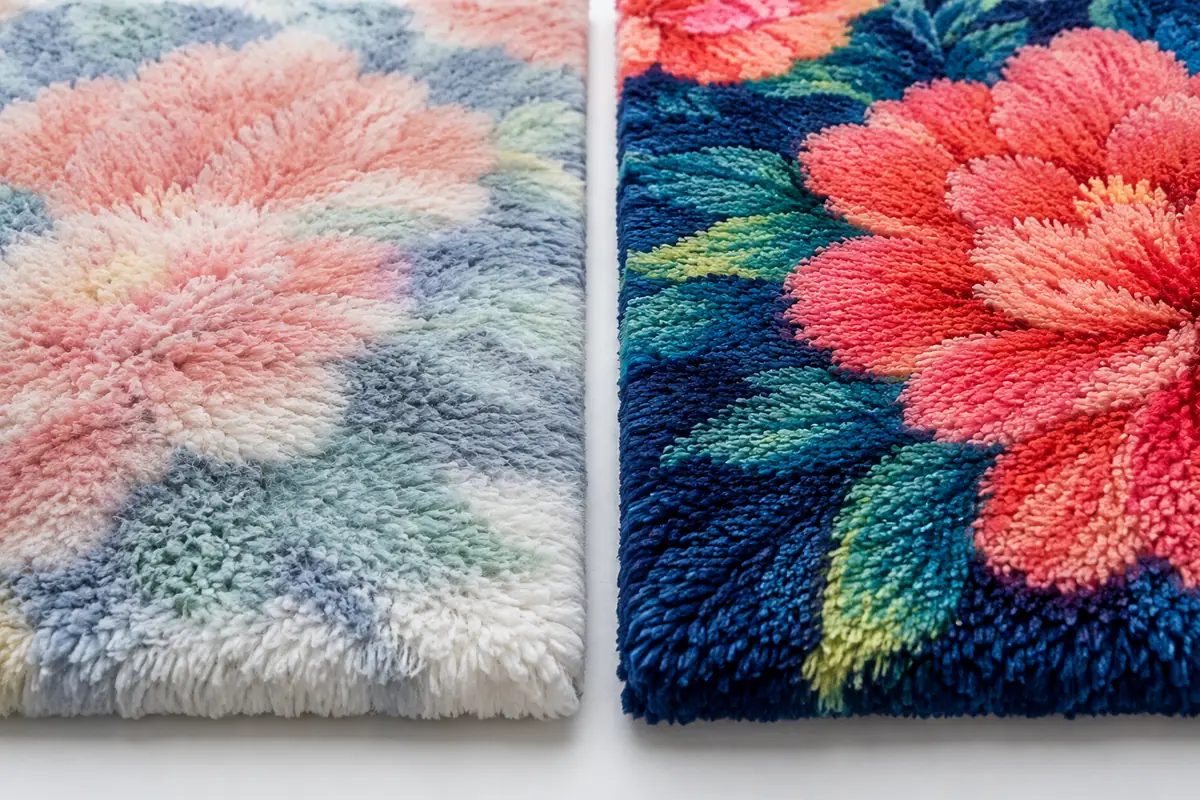
The output tells the story: frosty white patches where pile roots show through. Blurred pattern edges where ink wicked sideways through loose fibers. Light shades that come out mottled no matter how many times the profile gets adjusted.
The problem isn't the printer. It's the ink. General-purpose high-energy disperse inks were never designed for the physics of deep-pile printing. INKBANK's R&D team decided the solution wasn't to adapt — it was to re-architect.
2. What Is High-Energy Disperse Direct-to-Fabric Printing?
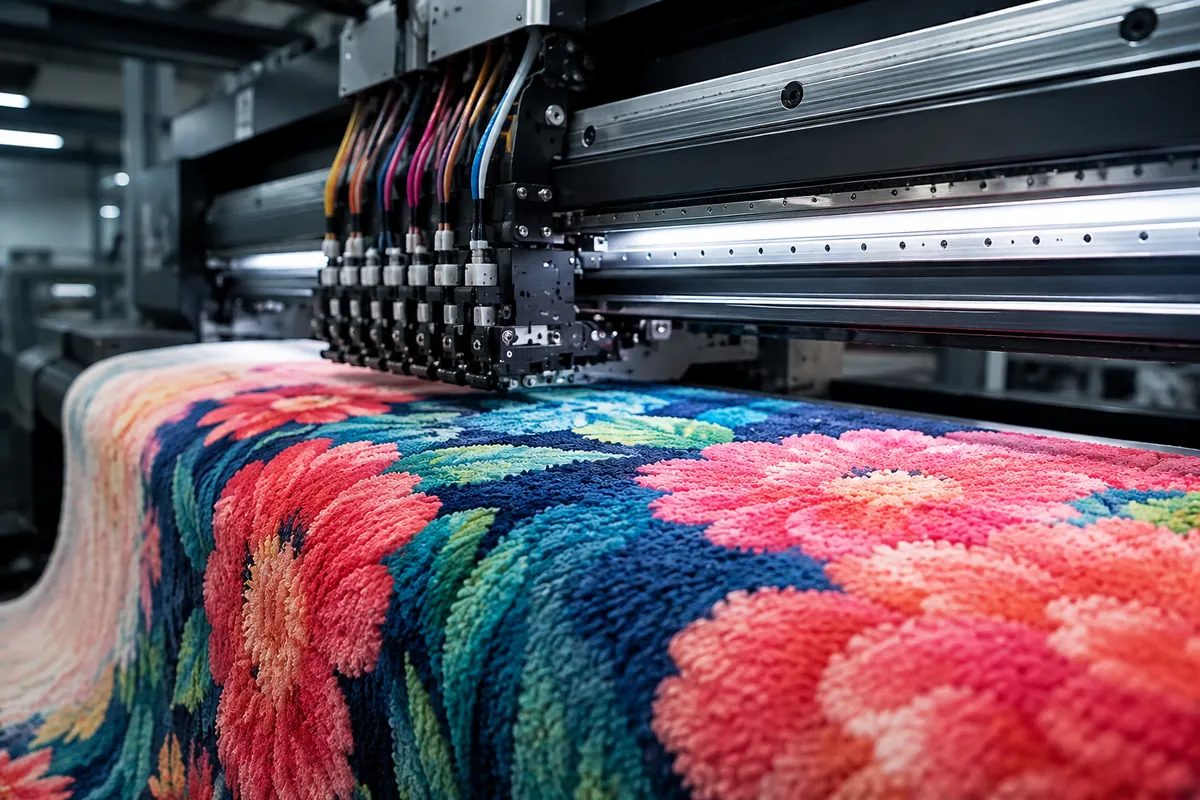
High-energy disperse direct-to-fabric (DTF) printing is a digital inkjet process in which high-molecular-weight disperse dye inks are jetted directly onto polyester textiles, followed by high-temperature fixation (typically 180–210°C). The heat sublimates the dye molecules, which then diffuse into the amorphous regions of the polyester fiber and become physically trapped as the polymer cools — producing permanent, wash-fast coloration.
Why DTF beats dye-sublimation transfer for pile fabrics:
| Advantage | Impact |
|---|---|
| No transfer paper required | Eliminates paper cost and solid waste |
| No secondary sublimation calender | Lower energy consumption, faster throughput |
| Direct fiber penetration | Preserves natural fabric hand feel |
| Cleaner environmental profile | Reduced consumable waste, lower carbon footprint |
But these advantages only materialize if the ink is engineered specifically for the unique physics of pile.
3. Three Bottlenecks Blocking Mass Production
The physics of jetting ink onto 2mm+ polyester pile is fundamentally different from flat woven fabric. Three failure modes appear consistently across production lines — and all three originate in the ink formulation, not the hardware.
Bottleneck 1: Insufficient Penetration → Exposed White Roots
When a 2mm pile fabric passes under the printhead carriage, ink droplets land on fiber tips. On flat fabric, that's where they stay — and that's fine, because there's nothing underneath to see. On pile fabric, the fiber roots are buried deep in the structure. If the ink doesn't travel down the fiber shaft, those roots remain white.
The result: shift the pile, bend the fabric, or view it from any angle other than straight perpendicular — and white, unprinted roots flash through. The print looks "frosty," "dusty," or "washed out."
Root cause: General-purpose disperse inks are formulated with surface-level wetting agents designed for flat substrates. No RIP profile compensates for ink that never reaches the root.
Bottleneck 2: Uncontrolled Lateral Diffusion → Blurred Patterns
Pile fibers are loose. The interstitial void space between fibers is enormous relative to fiber diameter. When a low-viscosity ink droplet lands, it doesn't just travel downward — it wicks sideways through the capillary network between fibers.
A crisp 2pt line becomes a feathered smear. Geometric patterns bloom with unintended halos. Text edges dissolve into fuzz.
Root cause: This is a rheology problem. The deeper the pile, the more inter-fiber channels exist for lateral wicking. General-purpose inks lack the viscosity modifiers and surface tension controls to limit it.
Bottleneck 3: Light Shade Instability → Mottling, Speckling, Batch Variation
Light shades — pastels, skin tones, soft gradients — use low dye-load formulations. At low concentrations, the dispersion system that keeps dye particles uniformly suspended becomes fragile.
On flat fabric, a slight concentration variation might read as an acceptable ΔE. On a three-dimensional pile surface, the same variation amplifies into visible mottling, speckling, and color flowers.
Root cause: Low dye-load formulations have the least material to anchor a stable dispersion. Phase separation, particle aggregation, and settling become more likely as dye concentration decreases. Batch-to-batch consistency becomes a recurring cost in rework and customer returns.
4. INKBANK's Four-Dimensional Solution
INKBANK didn't incrementally reformulate a general-purpose disperse ink. The R&D team re-engineered the system across four dimensions:
Dimension 1: High-Temperature S-Type Migration-Resistant Dye System
The foundation: High-molecular-weight disperse dyes classified as S-Type — selected for superior thermal stability at the temperatures polyester pile fabrics demand.
At 180–210°C, lower-molecular-weight disperse dyes become mobile. They sublimate and migrate from their printed position, causing color shift, ghost halos around edges, and cross-contamination between adjacent colors during the fixation cycle. The larger molecular structure and higher sublimation energy barrier of S-Type dyes resist this migration.
Production impact:
Color registration holds through curing
Edge definition survives the heat
Multi-color prints emerge from fixation looking the way they looked coming off the printer
Dimension 2: Low-Diffusion, High-Definition Formulation System
The balancing act: Vertical penetration deep enough to reach the fiber root, paired with lateral containment strong enough to prevent inter-fiber wicking.
INKBANK's formulation controls droplet wetting behavior from the moment of impact. A calibrated surface tension profile drives the ink downward along the fiber axis toward the root, while a viscosity modifier suppresses radial capillary spread through the fiber gaps.
Production impact:
Fine lines stay fine
Text stays readable
Geometric patterns keep their edges
On pile fabrics where crisp definition was previously impossible, detail printing becomes routine
Dimension 3: Dedicated Wetting & Suspension System for Light Shades
The challenge: Light-shade inks carry the least dye solids — which means the least material to anchor a stable dispersion.
INKBANK engineered a dedicated wetting and suspension system specifically for low-load formulations. By strengthening the dispersant network at low dye concentrations, the system maintains uniform particle distribution across all shade levels.
Production impact:
Pastel pink on meter one matches pastel pink on meter five thousand
Color-matching cycles shrink significantly
Rework from light-shade defects drops
Dimension 4: High Fluidity & Extended Idle Stability
The operational reality: Pile fabric production runs are long. Printheads operate continuously for hours. Between jobs, ink sits idle in supply lines, manifolds, and nozzles — sometimes for a full shift change or longer.
INKBANK developed a proprietary moisture-retention and anti-crusting formula that keeps nozzles wet during idle periods and maintains consistent jetting viscosity across extended runs.
Production impact:
Longer uninterrupted production windows
Fewer mid-run cleaning cycles
Less fabric waste from print defects caused by missing nozzles
5. Technical Specifications
| Ink Type | High-Energy Disperse Dye Ink (Direct-to-Fabric) |
| Dye System | S-Type high-molecular-weight migration-resistant disperse dyes |
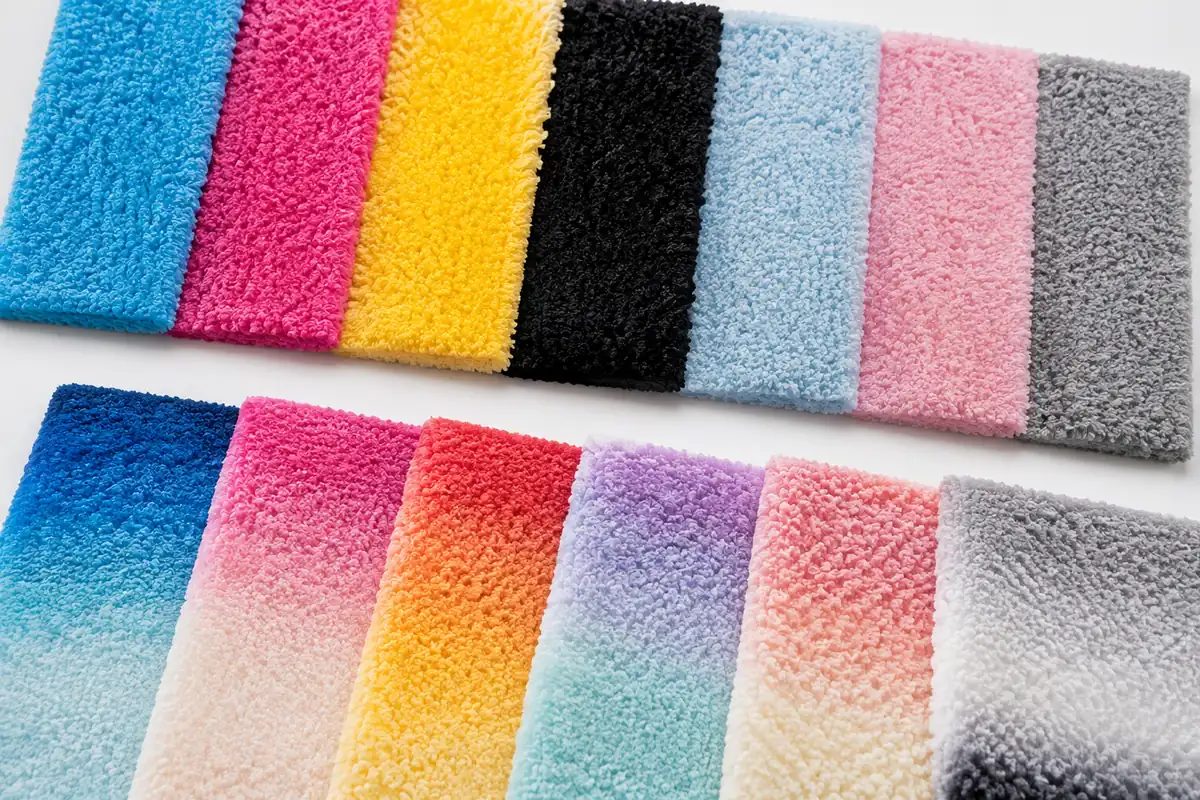
| Process Colors | Cyan, Magenta, Yellow, Black, Light Cyan, Light Magenta, Light Black |
| Spot Colors | Blue, Orange, Red |
| Fixation Method | High-temperature baking or steam fixation |
| Fixation Temperature | 180–210°C |
| Compatible Printheads | FUJIFILM SG1024 and major industrial printhead series |
| Compatible Fabrics | Coral fleece, polyester flannel, crystal super soft fleece, sailo fleece, and other polyester pile fabrics (≥2mm pile height) |
| Key Features | Low-diffusion formulation, light-shade suspension system, extended idle stability, anti-crusting |
Product page: High-Energy Disperse Dye Ink
6. Why This Matters for Your Production Line
1. Pile fabrics are a high-volume, high-margin category. Blankets, throws, loungewear, plush toys, automotive interior textiles — demand is growing steadily, and digital production offers significantly faster turnaround than traditional rotary-screen pile printing. The only thing holding mills back has been ink that works reliably at pile heights above 2mm.
2. The three failure modes share one root cause. Exposed roots, bleeding edges, and mottled light shades are not three separate problems requiring three separate fixes. They are three symptoms of one underlying issue — ink formulated for flat fabric, not pile. INKBANK's four-dimensional refactor addresses the cause, not the symptoms.
3. The cost of ink-related defects far exceeds the ink itself. Rework, fabric waste, machine downtime, and missed delivery deadlines compound quickly when prints fail. Mills that switch to a purpose-engineered pile-fabric ink see the difference in their defect rate and on-time delivery rate — not their ink invoice.
4. One partner, full portfolio. INKBANK's textile ink portfolio covers reactive, acid, disperse, pigment, and sublimation technologies — meaning one supplier relationship supports your entire production floor.
7. Frequently Asked Questions
Q1: What makes this ink different from standard high-energy disperse inks on pile fabrics?
Standard disperse inks are formulated for flat woven polyester. On 2mm+ pile fabrics, they fail across three dimensions: insufficient vertical penetration (exposed white roots), uncontrolled lateral diffusion (blurred edges), and light-shade instability (mottling, speckling). INKBANK's formulation addresses all three through S-Type dye selection, a low-diffusion rheology system, and a dedicated light-shade suspension architecture.
Q2: Which printheads are compatible?
FUJIFILM SG1024 and major industrial printhead series, including widely adopted Kyocera, Epson, and Ricoh industrial heads. Contact INKBANK's application engineering team to verify compatibility with your specific printhead model and waveform configuration.
Q3: What polyester pile fabrics can this ink print on?
Coral fleece, polyester flannel, crystal super soft fleece, sailo fleece, and other polyester pile fabrics with pile heights of 2mm and above. Suitable end-use categories include blankets, throws, loungewear, plush toys, and automotive interior textiles.
Q4: What colors are available?
Seven process colors: Cyan, Magenta, Yellow, Black, Light Cyan, Light Magenta, Light Black. Three spot colors: Blue, Orange, Red. Custom spot color matching available upon request.
Q5: What fixation method does the ink require?
High-temperature baking or steam fixation at 180–210°C, compatible with standard polyester pile fabric post-treatment lines. Our application engineers provide recommended time-temperature profiles for your specific fabric construction.
Q6: How does the ink perform on light/pastel shades?
The dedicated low-load suspension system maintains uniform dye particle distribution at the lowest concentrations, eliminating the mottling and speckling defects that general-purpose disperse inks commonly produce on light-shade pile prints. Production testing confirms ΔE < 1.5 across 5,000-meter production runs for pastel formulations.
Q7: Does the ink cause nozzle clogging during long runs or idle periods?
No. The proprietary moisture-retention and anti-crusting formulation extends idle stability and maintains consistent jetting across extended production runs, significantly reducing mid-run nozzle dropout. Internal testing demonstrates stable jetting after 8+ hours of idle time.
Q8: How does ink consumption compare to general-purpose disperse inks on pile fabrics?
While INKBANK's formulation may have a slightly higher upfront cost per liter, total ink consumption per square meter is typically 10–15% lower on pile fabrics due to controlled penetration depth — less ink is wasted saturating fiber tips without reaching the root. Combined with reduced rework, the total cost of ownership is consistently lower.
Related Resources
High-Energy Disperse Dye Ink — product page and technical data
Digital Textile Printing Inks — full INKBANK textile ink portfolio
Unlock Vibrant Polyester Prints with INKBANK High-Energy Disperse Ink — product announcement
Contact INKBANK — request samples or application support
8. Request Evaluation Samples
INKBANK's High-Energy Disperse Dye Ink for polyester pile fabrics is available for production testing.
What we need from you:
Fabric type and pile height
Printhead model and printer configuration
Current fixation process parameters
What you'll receive:
Color-matched ink sample set (7 process + your choice of spot colors)
Recommended print parameters and waveform settings
ICC profile baseline for your fabric
Application engineer support throughout your trial
Or explore INKBANK's full digital textile ink portfolio for additional specifications.
INKBANK Group — Over 20 years of digital inkjet ink R&D and manufacturing. 50+ patents. 40,000-ton annual capacity. Products shipped to 100+ countries. ISO 9001 / ISO 14001 / OEKO-TEX® ECO PASSPORT certified. RoHS & REACH compliant. The information above reflects INKBANK's formulation design for polyester pile fabric applications. Individual production results may vary based on fabric construction, equipment configuration, and process parameters.
