


By INKBANK R&D Inkjet Lab
Last updated: September 14, 2026
DTF ink is a water-based pigment ink used in direct-to-film printing. It is printed onto PET film, bonded with a hot-melt adhesive, cured, and heat-pressed onto fabric. CMYK colors form the image, white ink creates opacity, and the adhesive layer joins the transfer to cotton, polyester, blends, and other materials.
That definition explains what DTF ink is, but it does not explain why two print shops can use similar ink and obtain different results. DTF is a five-part production system: ink, film, adhesive or powder, curing, and heat press. The ink is central, but it cannot compensate for the wrong film, incomplete curing, uneven powder, or an unstable press.
This guide explains what DTF ink contains, how it works, where it fits, where it does not, and how production teams can evaluate it before committing to a large order.
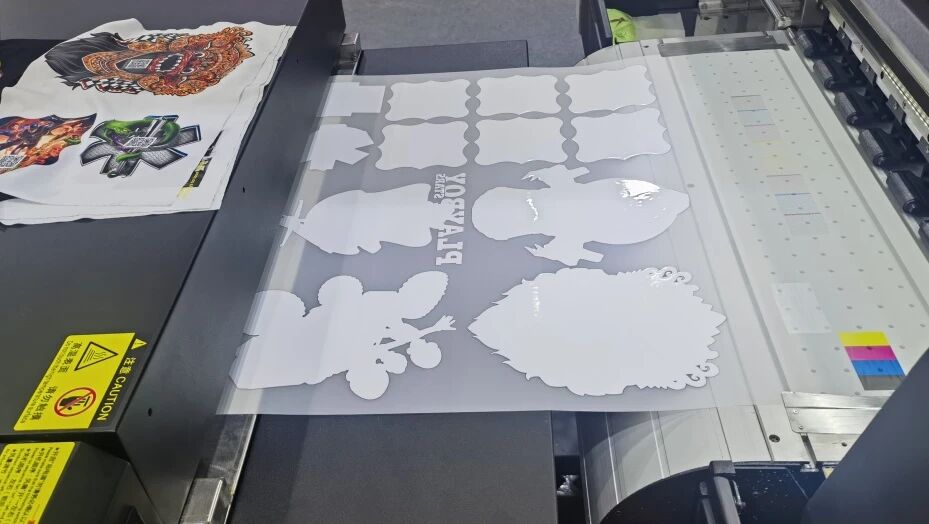
What Is DTF Ink?
DTF ink is a pigmented inkjet ink designed to form a transfer on PET film. The printed and cured transfer can be stored and then heat-pressed onto fabric later. This separates the printing step from garment finishing, which is useful for custom orders, mixed apparel products, and production planning.
DTF is not dye-sublimation ink. Sublimation turns into gas and dyes compatible polyester fibers. DTF remains a printed pigment layer carried on film and attached to fabric with an adhesive system. That difference explains why DTF supports more fabric types, while sublimation usually provides a lighter hand on polyester.
What Is DTF Ink Made Of?
DTF ink usually contains a water-based carrier, pigment dispersion, polymeric binder, dispersants or wetting agents, and humectants or other performance additives. Exact formulations vary by printhead and application.
| Component | Function | Why it matters in production |
|---|---|---|
| Water-based carrier | Carries the formulation through the printhead | Supports inkjet jetting and low-odor handling |
| Pigment dispersion | Creates color and opacity | Controls color strength, brightness, and lightfastness |
| Polymeric binder | Helps the pigment layer remain coherent and flexible | Influences adhesion, cracking, stretching, and hand feel |
| Dispersants and wetting agents | Keep pigment particles separated and stable | Reduce settling, nozzle blockage, and inconsistent coverage |
| Humectants and performance additives | Manage drying, viscosity, and printhead behavior | Affect idle stability, clogging, and print consistency |
White DTF ink carries a much higher load of dense white pigment, commonly based on titanium dioxide. This supports strong opacity on dark garments, but it also makes white ink more prone to settling. A DTF printer therefore needs reliable white ink circulation and maintenance.
Buyers should ask for the compatible printhead range and recommended ink limits rather than assuming that every water-based DTF ink can run in every DTF printer.
Why Does DTF Ink Need a White Layer?
White ink creates an opaque foundation so CMYK colors remain visible and consistent on dark or colored garments. Without enough white opacity, the fabric color can change the appearance of the transferred image.
A weak white layer can produce dull colors, uneven opacity across large solid areas, visible fabric color through fine details, patchy edges, or weaker color separation.
White ink quality should be evaluated on the actual garment color, fabric structure, film, and pressing setup. A white ink that looks dense on a test chart can still perform poorly if the transfer system is not matched.
How Does DTF Ink Work?
DTF ink works by printing a mirrored image onto PET film, applying an adhesive, curing the transfer, heat-pressing it onto fabric, and peeling the carrier film. Each step affects wash, stretch, and peel performance.
Step 1: Print the image onto PET film
The design is normally mirrored and printed onto a PET transfer film with a coated surface. Most systems print CMYK color channels and white ink. The printer, ICC profile, ink limits, and film coating must be matched.
Step 2: Apply the adhesive
In conventional DTF, a fine thermoplastic polyurethane, or TPU, hot-melt powder is applied to the wet printed area. The powder must be spread evenly and the excess removed. Too little adhesive can cause weak bonding; too much can create a stiff or uneven transfer.
Powderless DTF uses a printable liquid adhesive or integrated adhesive chemistry instead of the separate powder application step. This can shorten the workflow and reduce dust, but the finished transfer still needs to pass wash, stretch, peel, and storage tests.
Step 3: Cure the transfer
The film passes through a curing unit so the ink dries and the adhesive or powder reaches the correct state. Under-curing can leave the print weak and sticky. Over-curing can make the polymer layer brittle or damage the film.
Step 4: Heat-press the transfer
The cured film is placed on the garment and pressed. A common reference range is 160 to 170 C for 10 to 15 seconds, but the correct setting depends on the ink, film, powder or adhesive, fabric, and press. Hot peel or cold peel must follow the film specification.
Step 5: Peel and finish
After pressing, the carrier film is removed. The transfer should remain flat, flexible, and attached across its full surface. Inspect edge lifting, incomplete transfer, surface cracking, color loss, and changes in hand feel before packing.
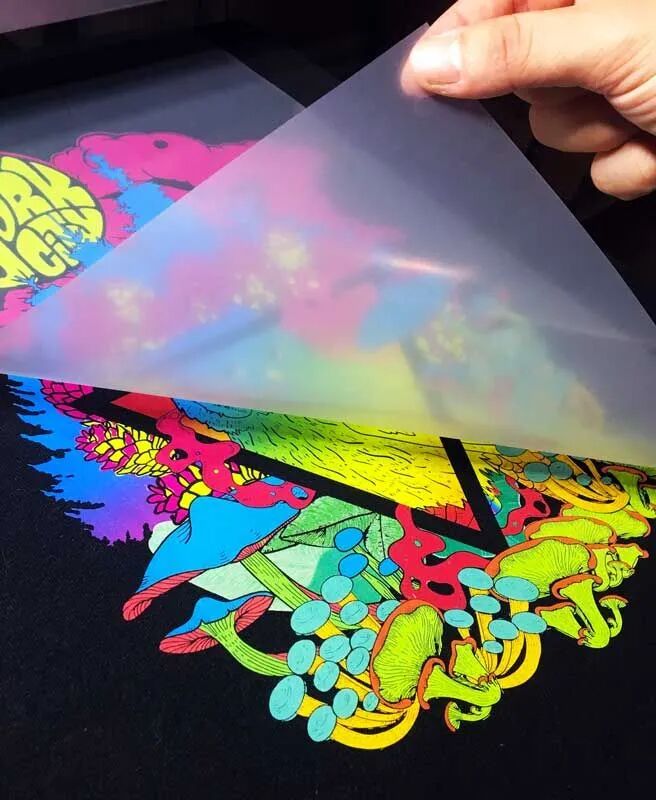
DTF Ink vs Other Digital Inks
DTF uses pigment ink transferred from film, DTG prints pigment ink directly on garments, sublimation dyes compatible polyester, and UV DTF uses a UV-curable transfer system for hard surfaces.
| Process | How color reaches the material | Typical fit | Main limitation |
|---|---|---|---|
| DTF | Pigment transfer from PET film with adhesive | Cotton, polyester, blends, mixed garment orders | Hand feel and system variables must be controlled |
| DTG | Inkjet ink printed directly on garment | Cotton-rich garments with suitable pretreatment | Narrower fabric range and pretreatment requirements |
| Sublimation | Disperse dye transfers into polyester fibers | Polyester and compatible synthetic fabrics | Limited performance on untreated cotton |
| UV DTF | UV-curable ink and adhesive system | Rigid, smooth, curved, or decorated hard surfaces | Different chemistry, curing, and durability profile |
DTF is often selected when a shop needs one transfer method for mixed fabrics or short-run orders. It is not automatically the best choice for every material. A product that requires a very light hand on polyester may be better suited to sublimation, while a smooth acrylic or metal item may require UV DTF rather than textile DTF.
Which Fabrics and Materials Suit DTF Printing?
DTF performs best when the adhesive can form a strong bond with the material. Cotton, polyester, and blends are common, while heat-sensitive and smooth rigid materials require careful qualification or a different process.
| Material | Typical suitability | What to verify |
|---|---|---|
| Cotton | Strong | White opacity, press pressure, wash durability |
| Polyester and blends | Strong when the full system is matched | Lower pressing temperature may be needed |
| Nylon and stretch fabrics | Possible | Stretch recovery, edge adhesion, curing window |
| Leather and coated textiles | Possible | Surface finish, heat sensitivity, adhesion test |
| Silk and heat-sensitive wool | Limited | Scorching risk and loss of hand feel |
| Glass, metal, and smooth plastics | Not conventional textile DTF | Use a suitable UV DTF or UV printing process |
The decisive test is not the fiber name alone. Fabric construction, dye migration, coating, stretch, heat sensitivity, and finishing process all affect the result.
What Problems Can Poor or Mismatched DTF Ink Cause?
The same visible defect can come from several parts of the transfer system, so diagnosis should include ink, film, adhesive, curing, and heat press.
| Symptom | Possible ink issue | Other variables to check |
|---|---|---|
| Missing nozzles or white banding | Sedimentation, filtration, compatibility, idle stability | Capping, wiper, humidity, circulation, maintenance |
| Cracking after stretching | Binder flexibility and ink load | Powder amount, curing, press pressure, film |
| Peeling after washing | Adhesion and binder performance | Powder, temperature, pressure, dwell time, fabric |
| Dull white on dark garments | White pigment load and dispersion | Film coating, white ink settings, curing |
| Color variation between jobs | Batch deviation or unstable pigment dispersion | ICC profile, printhead condition, film, curing |
| Stiff or heavy print | Ink laydown, white layer, adhesive amount | Transfer thickness and pressing |
For a process-focused diagnosis, see the DTF printhead maintenance guide.
How Should Production Teams Evaluate DTF Ink?
A useful evaluation combines printhead compatibility, white ink stability, physical quality data, batch consistency, and a production trial using the actual film, adhesive, fabric, curing unit, and press.
1. Confirm printhead compatibility
Ask for the exact printhead families and models covered by the ink. Confirm recommended voltage, waveform, ink limits, circulation requirements, and cleaning procedures. Compatibility with one Epson printhead does not automatically mean compatibility with every Epson DTF system.
2. Review white ink stability
White ink should remain suspended and recover cleanly after normal production pauses. Ask for idle recovery data that includes the printer model, idle duration, nozzle-check result, and recovery process.
3. Check physical quality data
Useful data includes pigment particle size, filtration level, viscosity range, surface tension, and storage stability. A number is only useful when the test method is included.
4. Test batch consistency
The INKBANK internal qualification framework targets inter-batch color deviation below Delta E 1.0. Buyers should verify this on their own printhead, ICC profile, film, and measuring device.
5. Run the five-material test
Test the ink with the film, powder or adhesive, fabric, curing unit, and heat press that will be used in production. A laboratory result based on a different combination is reference data, not a substitute for a shop-level trial.
6. Measure wash and stretch performance
Define the test before printing: number of wash cycles, water temperature and detergent, drying method, color change, cracking, edge lifting, peeling, hand feel, and stretch recovery.
For apparel programs, 20, 50, and 100-cycle tests can reveal whether a transfer degrades early or remains stable. The required level depends on the final market and garment specification.
7. Review compliance documents
Textile programs may require OEKO-TEX ECO PASSPORT, GOTS, ZDHC MRSL, REACH, or customer-specific restrictions. Confirm that the documents apply to the exact ink grade and production site.
For printhead-specific qualification, see the DTF ink compatibility guide.
What Is Powderless DTF Ink?
Powderless DTF removes the separate hot-melt powder application step by delivering the adhesive function through printable chemistry. It can reduce dust and process steps, but wash, stretch, peel, storage, and white opacity still require qualification.
The potential advantages include fewer process steps, less powder dust and cleanup, more consistent adhesive placement, and a thinner transfer in some constructions.
The qualification questions remain the same: Does the print survive repeated washing? Does it recover after stretching? Does it peel cleanly from the film? Does the adhesive remain stable during storage? Does white ink still provide enough opacity? Does the system fit the current printer and film?
The INKBANK 2-in-1 powderless DTF route combines the adhesive function with the ink workflow. It should still be validated on the fabric and finishing conditions used by the shop.
Is DTF Ink the Right Choice?
DTF is a strong fit for mixed fabrics, short and medium runs, detailed artwork, on-demand garments, and designs that need a white underbase.
DTF may not be the best fit when the product requires the lightest possible hand on polyester, the material is heat-sensitive, the surface is smooth glass, metal, or rigid plastic, or the shop cannot control curing, humidity, and printhead maintenance.
FAQ
Is DTF ink the same as sublimation ink?
No. DTF ink is a pigment ink transferred from film with an adhesive. Sublimation ink uses disperse dye that becomes gas and bonds into compatible polyester fibers.
Can DTF ink be used in a regular printer?
DTF ink requires a printer designed or modified for DTF, including white ink handling and circulation. A standard desktop printer without the correct printhead, ink system, and maintenance design is not suitable.
Why does DTF ink need white ink?
White ink provides an opaque underbase so CMYK colors remain bright and accurate on dark or colored garments.
Which fabric works well with DTF ink?
Cotton, polyester, and blends are common. Performance depends on the exact fabric, film, adhesive, curing, press settings, and wash requirement. Test before production.
Why do DTF prints crack or peel after washing?
Cracking or peeling can come from insufficient adhesive, incomplete curing, incorrect press pressure or temperature, the wrong film, incompatible ink, fabric stretch, or wash conditions. Diagnose the full transfer system.
Is DTF ink safe for skin contact?
After correct curing, many DTF prints are used on apparel. Ink selection and workplace safety still matter. Follow the supplier SDS, use suitable ventilation where powder is handled, and select certified grades for regulated textile programs.
How should DTF ink be stored?
Keep containers sealed and follow the supplier temperature and shelf-life instructions. Shake or circulate ink only as directed. White ink requires a maintenance routine that prevents settling.
Does powderless DTF ink still need testing?
Yes. Removing powder changes the process, but wash fastness, stretch, peel, storage, white opacity, and printhead compatibility still need production-level testing.
Need Help Matching DTF Ink to Your Production System?
Share the printer and printhead model, fabric, film, adhesive or powder, curing setup, press settings, and wash requirement with the INKBANK technical team. The team can review the transfer system and recommend a compatible DTF ink or sample direction.
Related resources: