 +86 188 1869 1624
 INKBANK01

By INKBANK Technical Editorial Team | 23 October 2026
High-concentration pigment ink improves book printing only when it shortens the path from ink droplet to saleable book. The formulation must reach the required black or color density at a lower wet laydown, dry before stacking or folding, and remain stable through idle and restart cycles. These are not three separate ink specifications. They are one production window.
This article is about water-based pigment inkjet ink used on uncoated or lightly coated offset book paper. It is not about traditional offset press ink, which is a paste ink transferred through a plate and blanket. The distinction matters because the two ink systems meet different fluid, drying and printhead requirements.
A high-concentration ink is useful when it delivers the target optical density with less liquid on the sheet without sacrificing dispersion stability, nozzle recovery or finishing performance. A repeatable result comes from matching pigment loading, binder behavior, humectants, paper absorption, dryer capacity, printhead waveform and line speed on the actual production route.
Concentration alone is not a quality specification. An ink can be highly concentrated and still fail if the pigment settles, the vehicle dries in the nozzle, the binder holds too much water at the surface, or the dryer cannot remove the remaining moisture before the next process.
The ink must be dry on paper and remain wet inside the printhead. It must hold pigment near the paper surface for density while allowing water and co-solvents to leave quickly. It must resist settling and drying during pauses while also forming a stable drop at high firing frequency.
Those requirements pull in opposite directions:
More humectant can extend nozzle open time but slow drying in the stack.
More binder can improve pigment fixation but may increase blocking, curl or film stiffness.
More pigment can raise density at lower laydown but can narrow the formulation and dispersion window.
More heat can accelerate drying but may distort the web, affect registration or create a fragile ink film.
More ink can cover a paper weakness but increases show-through, dot gain and finishing risk.
The useful question is therefore not "What is the pigment percentage?" It is "At what combination of ink, paper, print mode, dryer setting and finishing route does the line produce saleable books with repeatable density and acceptable waste?"
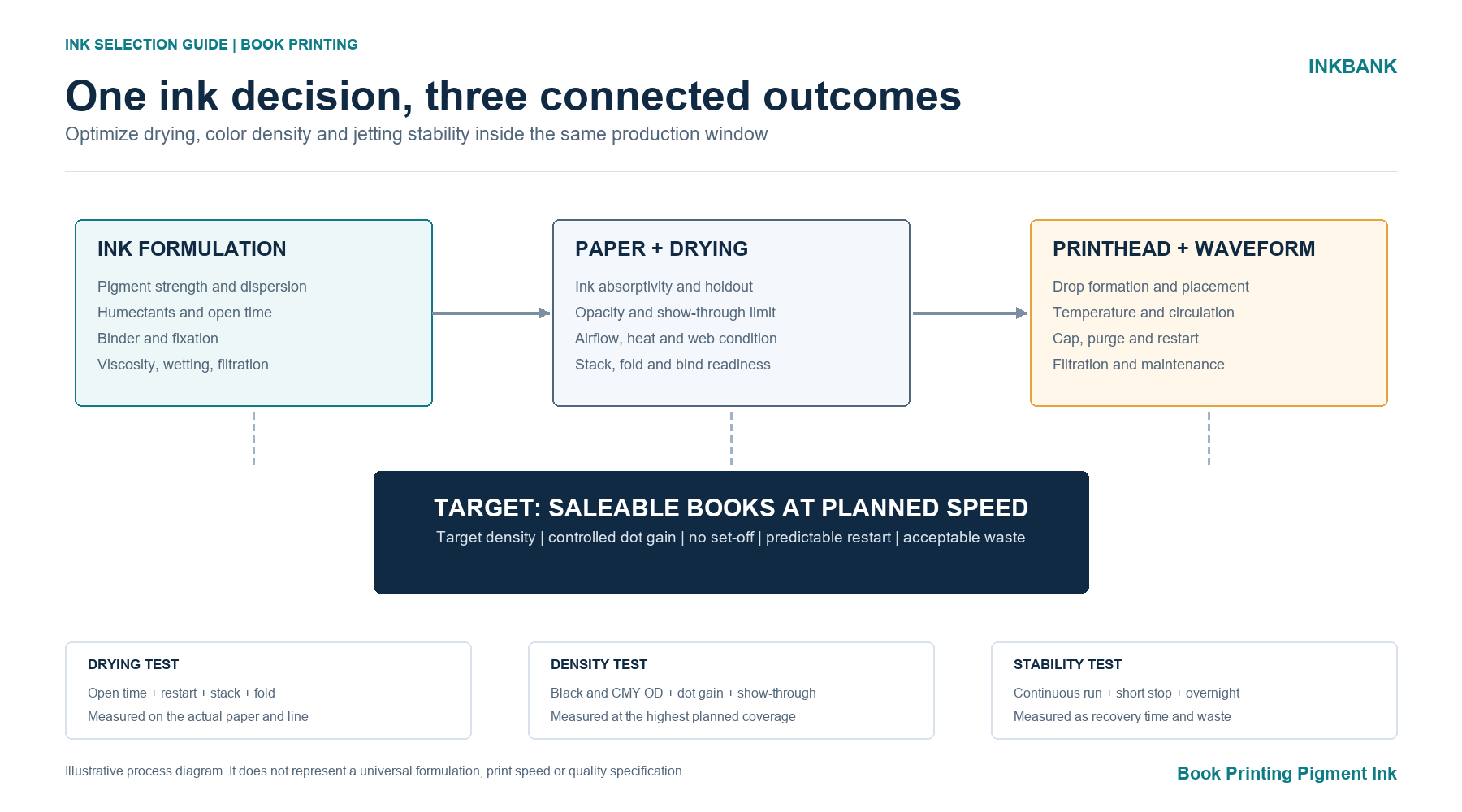
Figure 1. The book-printing ink production window. Ink concentration changes all three outcomes through the same vehicle, paper and drying system. Illustrative diagram; it does not represent a universal formulation or process specification.
For a finished inkjet ink, "high concentration" should be tied to a measurable result, not a single ingredient number. Ask for the color strength and optical-density performance on a defined paper at a defined drop volume, print mode and ink limit. Then compare the wet laydown required to reach that result.
A useful supplier discussion covers:
| Claim to clarify | Evidence to request | Why it matters |
|---|---|---|
| High color strength | Target optical density and color coordinates at a stated laydown | Separates real color efficiency from a darker-looking but wetter print |
| Small pigment particles | D50 and oversized-particle control, not D50 alone | A small average cannot compensate for a tail of large particles |
| Stable dispersion | Accelerated settling, filtration and thermal-cycle results | Predicts nozzle and filter risk during long runs and storage |
| Long standby | Open time, restart recovery and purge behavior on the specified head | A lab beaker test is not a printhead test |
| Fast drying | Drying measured on the customer's paper and dryer, followed by stack and fold checks | Paper absorption and dryer design dominate the result |
| Broad paper fit | Actual uncoated and coated book stocks, not one generic sheet | Offset paper grades differ in absorbency, opacity and surface chemistry |
INKBANK lists offset paper, booklet paper and coated paper among the substrates for its book printing pigment ink and states support for production speeds up to 100 m/min on the product page. Those are product-positioning claims, not universal process guarantees. The exact paper, print mode, head, waveform and finishing conditions still need a production trial. See the INKBANK book printing pigment ink product page for the current published specification and contact route.
The fastest way to misdiagnose a drying problem is to assume the dryer is too cold. In a high-speed book line, slow drying can also come from excessive ink laydown, a vehicle that holds water too strongly, a paper surface that absorbs unevenly, insufficient air movement, or a stack that traps moisture and heat.
AIC's October 2026 analysis describes the central conflict directly: the ink must resist drying inside the printhead while drying and fixing quickly enough on paper for the next operation. It also notes that pigment, vehicle, substrate treatment and drying cannot be selected independently. This is why a "faster drying" request should be split into at least three tests:
Nozzle open time: How long can the head idle before the first missing nozzles appear?
Restart quality: After a defined pause, how many purge cycles or how much recovery time are needed before full nozzle performance returns?
Post-press readiness: Can printed sheets be stacked, turned, folded or bound after the actual planned delay without set-off, blocking or marking?
Paper structure changes the job. A 2001 dot-gain study published by the Society for Imaging Science and Technology found that non-inkjet papers produced substantially more dot gain than inkjet papers in its tested samples, and that ink absorptivity correlated with dot gain while porosity and smoothness did not show a simple one-to-one relationship. The practical lesson is not that every uncoated paper behaves the same. It is that the paper grade and its interaction with the ink must be measured directly.
Run the drying trial at the highest ink coverage that will appear in the book, not only on a light text page. Include:
solid black and four-color image areas;
small text and reverse text;
both sides of the actual book stock;
the highest planned line speed;
a realistic stop, idle and restart sequence;
the exact stack height, folding pattern and binding delay.
If the print is dry at the exit of the dryer but marks in the stack, the problem has moved downstream. Record dryer air temperature, web temperature, airflow, humidity, web speed and stack time. Do not "fix" the symptom by reducing color density until the job no longer matches the proof.
Higher pigment concentration can improve density with a thinner wet film. It can also reduce show-through and the amount of water the dryer must remove. But density gains become unstable when the vehicle pulls pigment too deeply into the sheet, when the binder cannot hold the colorant near the surface, or when dot gain fills the midtones.
Measure density and image control together:
| Check | What it reveals | Where to measure |
|---|---|---|
| Black optical density | Text weight and perceived blackness | Solid patch and representative body text |
| CMY optical density | Color strength and ink efficiency | Individual solids and overprints |
| Midtone dot gain | Tone compression and edge control | 40% and nearby tint patches, where dot gain commonly peaks |
| Small-text raggedness | Drop placement and paper spread | Positive and reverse text at the smallest planned size |
| Show-through and strike-through | Excessive penetration or paper opacity limits | Reverse side of the highest-coverage page |
| Color drift through the run | Batch, temperature, waveform or drying instability | Start, middle and end of a production-length run |
The Inkjet Insight book-printing framework published by WhatTheyThink in 2017 provides a useful starting vocabulary for book segments. Its illustrative targets included black optical density above 0.85 and total ink coverage at or below 100% K for monochrome books, black density above 1.0 and CMY density above 1.10 for color books, and higher density targets for fine-art books. These are not universal pass/fail limits, and the article is now several years old. They are useful because they force the buyer to define the book type, paper, coverage and measurement method before comparing ink samples.
For a fair comparison, print the same ICC profile, RGB or CMYK test chart, resolution, print mode and paper. Measure after the same conditioning time. Otherwise a sample that simply uses more ink can appear to have better density.
A printhead can run cleanly for an hour and still fail the next shift. Pigment settling, local drying at the nozzle, foaming, filtration loading, temperature drift and waveform mismatch often appear at boundaries: after a pause, after a long weekend, during a speed change or when the ink is used near the end of a cartridge or supply container.
Use a staged stability test:
| Stage | Test condition | Record |
|---|---|---|
| Continuous production | Long run at planned speed and maximum realistic coverage | Missing nozzles, drop placement, temperature, pressure and waste |
| Short pause | Stop and restart at several planned interruption lengths | Recovery method and number of purge cycles |
| Extended idle | Overnight or weekend conditions matching the real line | Nozzle-out pattern, settling, filter pressure and ink circulation |
| Speed change | Ramp between low, normal and maximum line speed | Registration, satellite drops, density shift and edge quality |
| Consumable change | New container, partially used container and end-of-container | Density, color drift, particle or filter indicators |
| End-of-run | Last pages before planned maintenance | Whether the line remains saleable or depends on constant intervention |
AIC's report also emphasizes that pigment dispersion quality affects coloration, settling and nozzle reliability, while dispersion stability and paper fixation remain separate tasks. That distinction is important: a stable dispersion is necessary, but it is not sufficient. The finished ink still has to work with the binder, pretreatment, dryer and printhead.
For coated offset paper, Ricoh's technical description of its offset-coated-paper ink illustrates another route. The company says it modified wetting and drying behavior so small droplets could form the required dot with less ink, then reduced flowability quickly to limit dot blending. It is a different commercial system, but the engineering lesson is relevant: density, dot formation and drying are controlled by the whole fluid design.
Do not compare inks with a single print sample. Compare complete production windows.
| Variable | Minimum comparison | Decision question |
|---|---|---|
| Book stock | Each paper family and weight planned for production | Does the ink reach density without unacceptable show-through or curl? |
| Book type | Mono text, color trade book, image-heavy title | Which KPI set matters for this product mix? |
| Print mode | Draft, standard and highest quality actually sold | Is the quality gain worth the speed and ink cost? |
| Line speed | Normal production speed and planned maximum | Where does drying or jetting quality begin to fall? |
| Ink limit | Current RIP limit and one controlled alternative | Can density improve without making midtones or drying worse? |
| Dryer setting | Current validated setting and a small controlled range | Is the limit ink, paper, airflow or heat transfer? |
| Finishing route | Stack, fold, bind and trim as used in production | Does the printed sheet remain saleable after real handling? |
| Dwell and restart | Normal shift pattern, overnight and weekend | Is recovery predictable and acceptable? |
Use a scorecard rather than a single vote. For each sample, record optical density, color difference from the approved proof, dot gain, text raggedness, show-through, curl, blocking, nozzle-out rate, recovery time, waste sheets and measured throughput. Keep the failed samples. They explain why the selected ink is not merely the darkest sample.
| Symptom | Check first | Ink or vehicle lever | Process lever | Business consequence |
|---|---|---|---|---|
| Print looks weak but ink consumption is high | Actual laydown, paper absorption and color strength | Increase color efficiency without compromising stability | Lower ink limit or adjust ICC and print mode | Higher ink cost and slower drying |
| Solid density is acceptable but midtones look muddy | Dot gain, total ink coverage and paper absorbency | Improve dot formation and pigment fixation | Adjust tone curve, ink limit and dryer balance | Rejected color pages and remakes |
| Ink marks when sheets are stacked | Stack temperature, moisture, dwell and binder behavior | Rebalance humectant, binder and drying | Improve airflow, cooling and stack handling | Scrap, reprints and delayed finishing |
| Text becomes fuzzy on uncoated stock | Drop placement, paper spread and small-text raggedness | Tune wetting and pigment holdout | Adjust waveform, resolution and paper qualification | Lower perceived quality at the same nominal resolution |
| Nozzles drop out during pauses | Decap, circulation, filtration and temperature | Improve open time and dispersion robustness | Adjust maintenance, cap and purge routine | Unplanned stops and wasted signatures |
| Color drifts during a long run | Ink temperature, batch, drying and head condition | Stabilize dispersion and color strength | Control temperature, circulation and closed-loop measurement | Repeated setup and inconsistent reprints |
A lower price per liter can be expensive if it requires more ink per page, more heat, more purge cycles or more reprints. Build the comparison around delivered books:
Cost per 1,000 saleable books = ink + paper + energy + downtime + purge and cleaning + waste + rework + finishing + storage exposure
The dollar values will differ by plant. The structure should not. Include the cost of stops caused by nozzle recovery, the cost of rejected signatures after folding, and the value of releasing a title earlier. A high-concentration ink that reduces wet laydown can lower energy and drying load, but only if it does not create a new stability penalty.
This is also why a small "free sample" is rarely enough. A useful sample is tied to a technical data sheet, a defined head and waveform, a paper list, a storage recommendation and a test protocol. The supplier should be willing to explain which claims are measured, which are target values and which are application-dependent.
Ask these questions in writing:
What is the recommended printhead family and waveform validation process?
Which paper grades have been tested, and what were the test conditions?
How is color strength measured, and on what paper and laydown?
What is the expected open-time and restart behavior after a planned stop?
What filtration, circulation, temperature and storage limits apply?
How is batch-to-batch color controlled?
Which cleaning and maintenance chemicals are compatible with the ink system?
What evidence supports the claimed production speed?
What happens to density, dot gain and show-through at the highest planned coverage?
What support is available for ICC profiling, trial planning and failure analysis?
INKBANK's company profile records ISO 9001 and ISO 14001 management systems, 16 R&D and environmental test laboratories, more than 500 test printing units and experience supplying inkjet inks to customers in 100+ countries and regions. Those capabilities are relevant to a book-ink qualification program, but they do not replace a line trial on the customer's paper, dryer and finishing route.
INKBANK develops water-based pigment inks for book and periodical printing, including formulations positioned for offset paper, booklet paper and coated paper. The useful starting point is not a generic "high concentration" claim. It is a joint definition of the target book segment, the paper family, the printhead and waveform, the maximum ink coverage and the post-press route.
For a new project, send the following to the ink technical team:
the book type and representative pages;
paper grade, weight, opacity and supplier;
printhead architecture and current waveform;
target line speed and realistic pause pattern;
target black density, color coordinates and show-through limit;
dryer type and available temperature or airflow range;
folding, binding and stacking process;
current failure mode, waste rate and cost of poor quality.
That brief allows the conversation to move from an ink price per liter to an evidenced production window. If the line needs a lower wet laydown, the supplier can explain the density mechanism. If it needs faster stacking, the conversation can address vehicle and dryer behavior. If it needs longer standby, the discussion can focus on dispersion, humectancy and recovery.
It is a water-based pigment inkjet ink formulated to deliver a strong printed result with a relatively low wet laydown on offset book paper. Concentration should be judged by measured density, color strength, drying and jetting performance on the actual paper, not by one ingredient figure.
No. Offset paper pigment ink in this article means inkjet ink printed onto offset book paper. Traditional offset printing ink is a paste ink used with plates, blankets and fountain solution. Their rheology, drying and printhead requirements are different.
Color concentration and drying are separate formulation properties. A highly concentrated ink can still contain humectants or a vehicle that holds water strongly. Paper absorption, ink laydown, airflow, web temperature and stack conditions can also dominate the result.
Print a controlled test chart on the actual book stock at the planned ink limit and print mode. Measure black and CMY optical density, midtone dot gain, small-text raggedness, show-through and color drift through the run. Compare samples after the same conditioning time.
Possible causes include local drying at the nozzle, pigment settling or agglomeration, foam, filter loading, temperature drift, inadequate circulation or a maintenance routine that does not match the ink's open-time behavior. The fix may involve the ink, the head maintenance sequence or both.
No. Density can improve with a thinner wet film, but high pigment loading can narrow the stability and jetting window. The target is the lowest wet laydown that consistently reaches the required density and image quality without increasing maintenance, show-through or rework.
Use the actual paper, printhead, waveform, dryer and finishing route. Print mono, color and high-coverage pages at normal and maximum planned speed. Include pauses, restarts, stacking and folding. Measure density and defects at the start, middle and end of the run.
When show-through, dot gain, curl or color development remain unacceptable after the ink limit, waveform and dryer have been checked, the paper may be the limiting component. Compare opacity, ink absorptivity, surface treatment and paper weight before changing the ink again.
The fastest route to a useful ink decision is a trial brief built from the actual production route: book type, paper, printhead, waveform, target density, maximum coverage, line speed, pause pattern, dryer and finishing process.
Request a book-printing pigment ink trial from INKBANK and include the failure samples or measurement records that matter most. The goal is not to select the darkest sample in a laboratory. The goal is to identify the most stable production window for saleable books.
INKBANK, Book Printing Pigment Ink product page, accessed 23 October 2026.
AIC, "POD Book Printing Inks: How Web-Fed Inkjet Is Reshaping Publishing," 15 October 2026.
Elizabeth Gooding, "Inkjet Book Printing - What Matters?" WhatTheyThink, 1 August 2017.
Ricoh, "Ink for Offset Coated Paper," accessed 23 October 2026.
Related Products
Contact Us
Hello, welcome to submit any questions and suggestions. We will reply to you as soon as possible. Thank you for your support and help.


